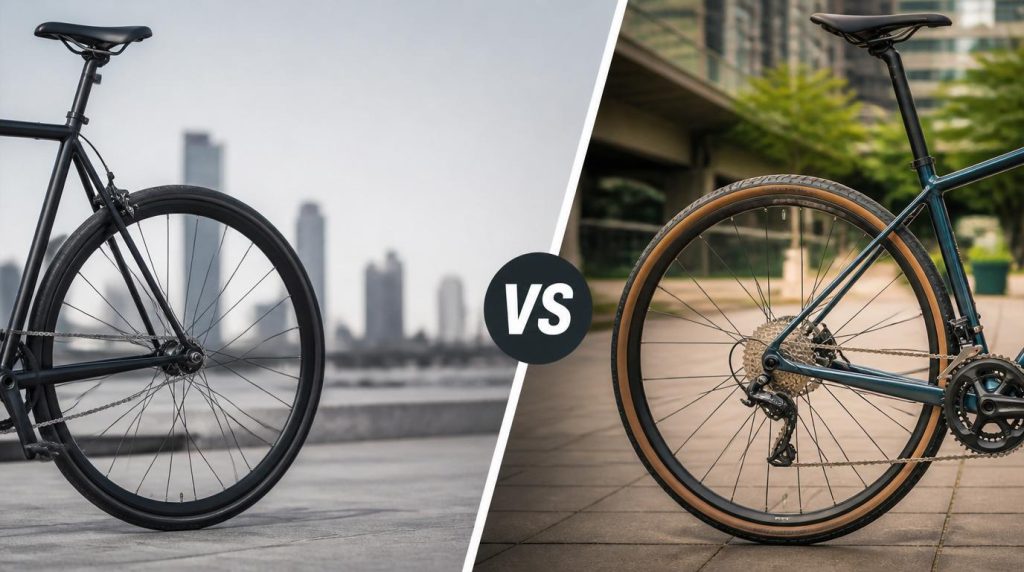
Single speed and fixed gear bikes strip cycling down to its simplest mechanical form: one chainring, one cog, no derailleurs, no shifting. This simplicity is exactly the appeal — but it also means you only get one chance to choose the right gear ratio. Get it wrong and every ride feels either like a constant grind uphill or a frantic spin on the flats.This guide explains how to choose a single speed gear ratio that actually suits your terrain, fitness, and riding style, and how single speed compares to a geared bike for different use cases.
Table of Contents
- Why Single Speed Gear Ratio Choice Matters So Much
- How Single Speed Gear Ratio Is Calculated
- Typical Single Speed Gear Ratios by Use Case
- Single Speed vs Fixed Gear: Does It Change the Ratio?
- How Terrain Affects Your Ideal Ratio
- Single Speed vs Geared Bike: Which Should You Choose?
- How to Use a Gear Ratio Calculator for Single Speed Setup
- How to Change Your Single Speed Ratio
- Common Mistakes to Avoid
- FAQ
Why Single Speed Gear Ratio Choice Matters So Much
On a geared bike, choosing a slightly imperfect cassette or chainring is rarely a serious problem — you have a range of gears to fall back on. On a single speed bike, you have exactly one gear ratio, all the time, on every surface and every gradient you encounter.
This makes the initial choice far more consequential. A ratio that is too high (hard) makes climbing genuinely difficult and starting from a stop strenuous. A ratio that is too low (easy) leaves you spinning frantically with no power on flats or descents, unable to reach a comfortable cruising speed.
Unlike a geared bike, there is no “good enough” middle ground that works adequately everywhere — the right single speed ratio is one that matches the realistic demands of where and how you actually ride.
How Single Speed Gear Ratio Is Calculated
The calculation is the same basic formula used for any gear ratio:
Gear Ratio = Chainring teeth ÷ Rear cog teeth
Example
A single speed bike with a 42-tooth chainring and a 16-tooth rear cog:
Gear Ratio = 42 ÷ 16 = 2.625
This is a moderate ratio suited to mixed urban riding — flat enough to be manageable from a stop, while still allowing reasonable cruising speed.
Why Single Speed Ratios Are Often Described Differently
Single speed and fixed gear riders sometimes describe their setup using just the two tooth counts (e.g., “42/16”) rather than the calculated ratio, since the specific combination also affects chainline and chain length, not just the resulting ratio. Two different combinations can produce a very similar ratio (42/16 = 2.625, and 45/17 = 2.65) while having slightly different practical characteristics.
Typical Single Speed Gear Ratios by Use Case
Urban Commuting (Flat to Rolling Terrain)
| Setup | Gear Ratio | Character |
|---|---|---|
| 42/18 | 2.33 | Easier — good for frequent stops |
| 42/16 | 2.63 | Moderate — balanced for mixed riding |
| 44/16 | 2.75 | Slightly harder — better cruising speed |
Most urban single speed commuters settle in the 2.3–2.8 range, balancing the ability to accelerate from frequent stops at traffic lights with reasonable cruising speed between them.
Hilly Urban or Mixed Terrain
| Setup | Gear Ratio | Character |
|---|---|---|
| 40/18 | 2.22 | Easier climbing, lower top speed |
| 42/18 | 2.33 | Balanced for moderate hills |
Riders in hillier cities often choose a noticeably lower ratio than flat-terrain commuters, accepting reduced top speed on the flats in exchange for climbs that remain manageable without excessive standing or strain.
Track and Velodrome (Fixed Gear)
| Setup | Gear Ratio | Character |
|---|---|---|
| 50/14 | 3.57 | Sprint-oriented |
| 49/15 | 3.27 | Endurance/pursuit-oriented |
Track cycling uses much higher ratios than road or commuting single speed setups, since velodrome racing involves sustained high speed with no need to climb or stop.
Single Speed Mountain Biking
| Setup | Gear Ratio | Character |
|---|---|---|
| 32/18 | 1.78 | Technical, steep singletrack |
| 32/16 | 2.00 | Moderate trail riding |
| 34/16 | 2.13 | Faster, less technical trails |
Single speed MTB ratios are significantly lower than road equivalents, reflecting the need to climb steep, technical terrain without the option to shift down.
Single Speed vs Fixed Gear: Does It Change the Ratio?
The gear ratio calculation itself is identical for single speed (freewheel) and fixed gear bikes — the formula does not care whether the rear cog can spin freely or is fixed directly to the wheel.
However, the practical ratio choice often differs between the two:
Single Speed (Freewheel)
Since you can coast, riders often choose a slightly higher (harder) ratio than they might on a fixed gear, since there is no need to keep pedalling on descents — you simply coast and let the higher ratio provide better cruising speed on flats.
Fixed Gear
Since the pedals are always turning with the wheel, an excessively high ratio becomes uncomfortable on descents (pedals spin too fast to control smoothly) and an excessively low ratio becomes exhausting on flats (constant high-cadence spinning with no ability to coast and rest). Fixed gear riders often choose a slightly lower ratio than an equivalent single speed freewheel rider, prioritising a manageable cadence across the full range of speeds encountered, since coasting is not an option.
How Terrain Affects Your Ideal Ratio
Flat Terrain
Higher ratios (2.6–3.2) work well, maximising cruising speed potential since there is little need for an easy climbing gear.
Rolling or Mixed Terrain
Moderate ratios (2.2–2.6) provide a reasonable balance, manageable on the climbs you will encounter while still offering decent speed on flats.
Hilly Terrain
Lower ratios (1.8–2.2) become necessary to keep climbs manageable, accepting a lower top speed on flats and descents as the trade-off.
Mixed Surface (Gravel, Light Trail)
Lower ratios than road equivalents are generally needed, similar to the single speed MTB ranges above, reflecting both surface resistance and the likelihood of technical or steep sections.
Single Speed vs Geared Bike: Which Should You Choose?
Reasons to Choose Single Speed
- Mechanical simplicity — no derailleurs, shifters, or cassette to maintain, adjust, or replace
- Lower maintenance cost — fewer components to wear out or break
- Lighter weight — removing derailleurs, shifters, and cassette saves meaningful weight
- Reliability — fewer failure points, particularly valuable for daily commuting in poor weather
- Simplicity of riding experience — many riders enjoy the directness and mechanical connection of a single gear, particularly on fixed gear bikes
Reasons to Choose a Geared Bike
- Terrain flexibility — a wide gear range handles varied terrain without compromise
- Easier on the knees — being able to shift to an easier gear on climbs reduces strain compared to forcing a fixed ratio
- Better for longer or more varied rides — multi-terrain rides benefit significantly from gear range
- More accessible for less experienced or less fit riders — removes the need to “grind through” a difficult ratio on unexpected climbs
A Practical Decision Framework
| Your Situation | Recommendation |
|---|---|
| Flat city commute, short distance | Single speed — simplicity wins |
| Hilly city or varied terrain commute | Geared — range matters more |
| Track racing or fixed gear riding for its own sake | Single speed (fixed) — matches the discipline |
| Long-distance or touring riding | Geared — terrain variety demands range |
| Minimal maintenance priority, flat area | Single speed |
| Fitness and terrain uncertain or varied | Geared — safer default choice |
How to Use a Gear Ratio Calculator for Single Speed Setup
Choosing a single speed ratio by trial and error means buying and trying multiple chainrings and cogs — an expensive and time-consuming way to find your ideal setup.
Our Gear Ratio Calculator lets you input any chainring/cog combination and see:
- The resulting gear ratio
- Gear inches and development for comparison against bikes you have ridden before
- Speed at a given cadence — useful for estimating realistic cruising speed for a candidate ratio before committing to parts
How to use it for single speed setup:
- If you have ridden a geared bike and know which gear (chainring/cog combination) you use most often on similar terrain, calculate that ratio first as a reference point
- Compare candidate single speed ratios against that reference, adjusting based on whether you want a fixed gear (favouring slightly lower) or freewheel single speed (can run slightly higher)
- Check the resulting speed-at-cadence figures against your actual riding — does the ratio allow a comfortable cadence at your typical cruising speed?
How to Change Your Single Speed Ratio
If your current ratio is not working well, changing it usually means swapping the rear cog, the chainring, or both.
Changing the Rear Cog
Generally the simpler and cheaper change, particularly on bikes with a standard freewheel or fixed cog thread. Swapping to a larger cog lowers the ratio (easier); a smaller cog raises it (harder).
Changing the Chainring
Often requires removing the crankset or at minimum the chainring bolts, and may be limited by your specific crankset’s bolt circle diameter (BCD), which determines what chainring sizes are physically compatible.
Chain Length Adjustment
Changing either component changes the required chain length. Use our Chain Length Calculator to determine the correct number of links for your new combination before cutting and rejoining the chain.
Common Single Speed Mistakes to Avoid
Mistake 1: Copying Someone Else’s Ratio Without Considering Terrain
A ratio that works perfectly for a friend’s flat commute may be unworkable on your hillier route. Always consider your specific terrain rather than directly copying another rider’s setup.
Mistake 2: Choosing Too High a Ratio for “Better Speed”
A higher ratio sounds appealing for top speed, but if it makes starting from stops and climbing genuinely difficult, the practical result is often a worse riding experience overall, not a better one.
Mistake 3: Underestimating Hills on Your Route
Many riders choose a ratio based on the flattest parts of their commute and are caught out by even moderate hills elsewhere on the route. Consider the hardest section of your typical ride, not just the average terrain.
Mistake 4: Not Accounting for Coasting Ability When Choosing Fixed vs Freewheel Ratios
A ratio that works well on a freewheel single speed (where you can coast on descents) may be uncomfortably fast-spinning on a fixed gear version of the same setup, where the pedals must keep turning with the wheel at all times.
Mistake 5: Forgetting Chain Length Changes With Ratio Changes
Changing chainring or cog size changes the required chain length. Skipping this check after a gear change can result in a chain that is too tight or too loose for the new combination.
FAQ
What is a good gear ratio for a single speed commuter bike?
For flat to rolling urban terrain, a gear ratio between 2.3 and 2.8 generally provides a good balance between manageable acceleration from stops and reasonable cruising speed. Hillier routes typically call for a lower ratio, in the 2.0–2.3 range.
Is a higher gear ratio better for a single speed bike?
Not universally. A higher ratio allows faster cruising speed but makes climbing and accelerating from stops harder. The right ratio depends on your terrain and riding style, not simply choosing the highest number for maximum potential speed.
What is the difference between single speed and fixed gear ratios?
Not universally. A higher ratio allows faster cruising speed but makes climbing and accelerating from stops harder. The right ratio depends on your terrain and riding style, not simply choosing the highest number for maximum potential speed.
How do I calculate my single speed gear ratio?
Divide your chainring’s tooth count by your rear cog’s tooth count. For example, a 42-tooth chainring with a 16-tooth cog gives a ratio of 2.625. Use our Gear Ratio Calculator to calculate this and compare it against other combinations instantly.
Should I choose single speed or a geared bike for hilly terrain?
A geared bike is generally the better choice for genuinely hilly or varied terrain, since it allows you to shift to an easier gear on climbs rather than being locked into one ratio for every gradient you encounter.
Does changing my single speed gear ratio affect chain length?
Yes. Changing either the chainring or rear cog size changes the chain length needed to properly wrap around both components. Use our Chain Length Calculator to determine the correct number of links after any gear ratio change.
Summary
Choosing the right single speed gear ratio means matching your one available gear to the realistic demands of your terrain and riding style — there is no shifting to bail you out of a poor choice.
Key takeaways:
- Gear Ratio = Chainring teeth ÷ Rear cog teeth, same formula as geared bikes
- Urban flat commuting: 2.3–2.8 is typical
- Hilly terrain: 1.8–2.2 keeps climbs manageable
- Fixed gear riders often prefer slightly lower ratios than freewheel single speed, since coasting is not possible
- A geared bike remains the better choice for genuinely varied or hilly terrain
Ready to calculate and compare single speed ratios? Use our Gear Ratio Calculator →