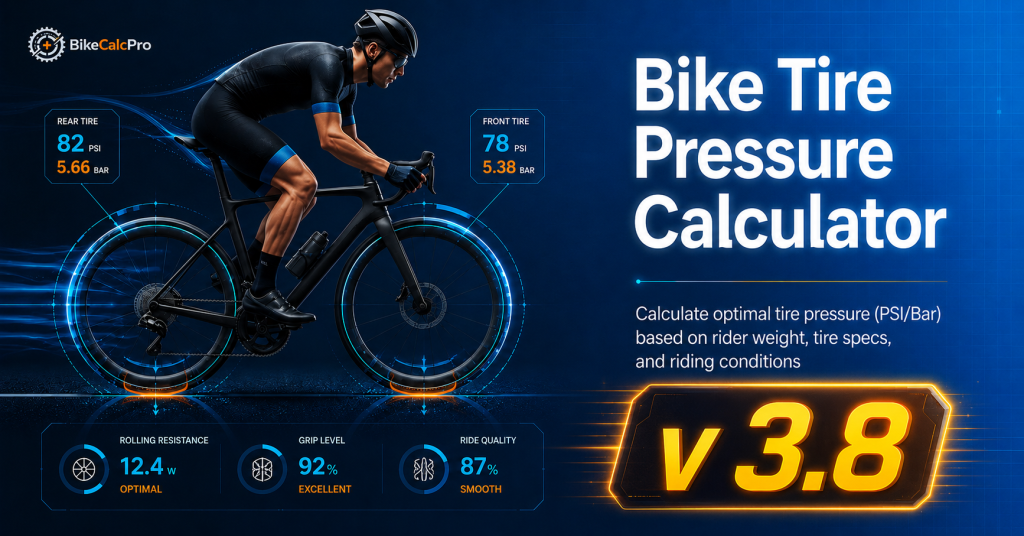
We listen to rider feedback seriously — and version 3.8 of our Bike Tire Pressure Calculator is the direct result of it. This update doesn’t change what the calculator does at its core. It makes the output more accurate for the way real cyclists actually ride: mixed surfaces, varied tire setups, and increasingly common hookless rims.
Here is everything that changed, and why it matters.
Mixed-Terrain Pressure Blending
The old approach to “mixed” riding was blunt: select Mixed, get a softened number somewhere between road and gravel pressure. It worked, but it didn’t reflect reality.
Version 3.8 replaces that with a percentage slider. You tell the calculator exactly what your ride looks like — 70% pavement and 30% gravel, or 40% tarmac and 60% trail — and it blends the pressure recommendation proportionally instead of applying a fixed offset.
Why this matters: a 30% gravel rider and a 70% gravel rider have genuinely different optimal pressures, sometimes by 8–12 PSI on the same tire. Treating both as “mixed” was leaving precision on the table. Now it doesn’t.
MTB Tire Tread Type
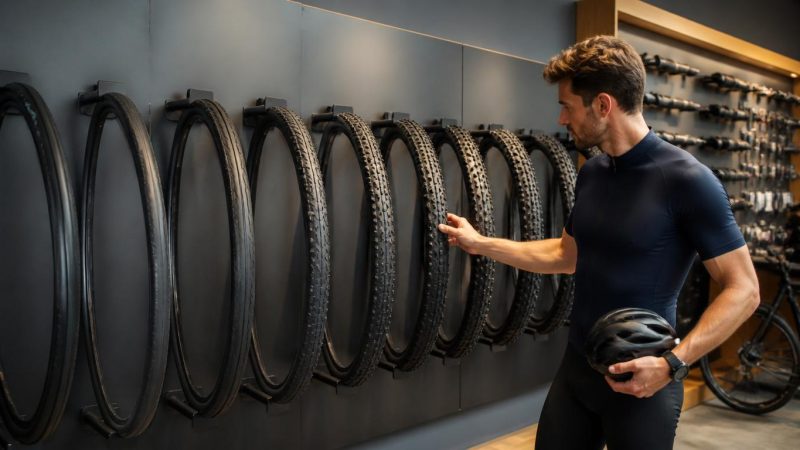
Until now, the calculator assumed every mountain bike tire was a full knobby. That assumption holds for trail and enduro riders, but not for XC racers or urban MTB commuters running semi-slick or slick tires.
Tread pattern directly affects the optimal pressure: a semi-slick tire on hardpack trails can run 3–5 PSI higher than a knobby at the same rider weight, because the lower rolling resistance profile doesn’t need the same deformation to generate grip.
Version 3.8 adds a Tire Tread field for MTB setups — knobby, semi-slick, or slick — and adjusts the recommendation accordingly. If you don’t know your tread type, the default (knobby) still applies and gives you a safe starting point.
Tire Casing Type
This one lives under the Advanced section, so it stays out of the way if you don’t need it — but it’s there for riders who do.
Casing type — lightweight racing versus puncture-resistant touring — affects both the stiffness of the tire and its deformation characteristics under load. A lightweight race casing at 80 PSI behaves differently from a reinforced touring casing at the same pressure: the race casing deforms more, which can actually improve rolling efficiency on imperfect surfaces at slightly lower pressures than a touring casing would need.
If you’re setting up a touring bike with Schwalbe Marathon-type tires, or a race bike with Continental GP5000 casings, the recommendation is now calibrated to match — not just your weight and tire width, but the physical properties of the tire itself.
Hookless Rim Safety Cap
Hookless rims are increasingly standard on gravel and road wheelsets from brands like Zipp, ENVE, and Hunt. They are lighter and aerodynamically cleaner than hooked rims, but they come with a hard maximum pressure limit: 72.5 PSI / 5.0 Bar, per the industry standard set by ETRTO.
Exceeding that limit on a hookless rim risks tire blow-off — sudden, complete loss of the tire bead seat. It’s rare, but the consequences are severe enough that the limit must be treated as absolute.
Version 3.8 adds a Hookless Rim toggle. When enabled, the calculator will never recommend above 72.5 PSI regardless of rider weight or tire width. If your inputs would otherwise push the result above that threshold, the recommendation is capped and a note is shown explaining why.
If you’re unsure whether your rims are hookless, check the inside of the rim bed: hookless rims have a smooth, rounded inner wall without the small raised hook that retains the tire bead on traditional rims.
Formula Consistency Across All Bike Types
Beyond the new inputs, v3.8 includes a behind-the-scenes refinement to the pressure formula itself — specifically in how road, gravel, MTB, and fat bike recommendations are calculated relative to each other.
In earlier versions, the multipliers for each bike type had accumulated small inconsistencies over time as individual adjustments were made. A 90 kg rider switching between Road and Gravel modes might see a pressure jump that felt slightly discontinuous. That has been smoothed out: the transitions between bike types now follow a consistent mathematical progression, so the numbers feel coherent whether you’re comparing setups or just exploring options.
Try It
The updated calculator is live now at the link below — same URL, no re-bookmarking needed.
→ Bike Tire Pressure Calculator
If something feels off with your result, or you have a setup we haven’t accounted for, use the contact form to let us know. Version 3.8 started as rider feedback.