Calculate optimal gear ratios, gear inches, and development for your bicycle setup
The gear ratio is calculated by dividing the number of teeth on the front chainring by the number of teeth on the rear cog. A higher gear ratio means more distance per pedal stroke but requires more effort.
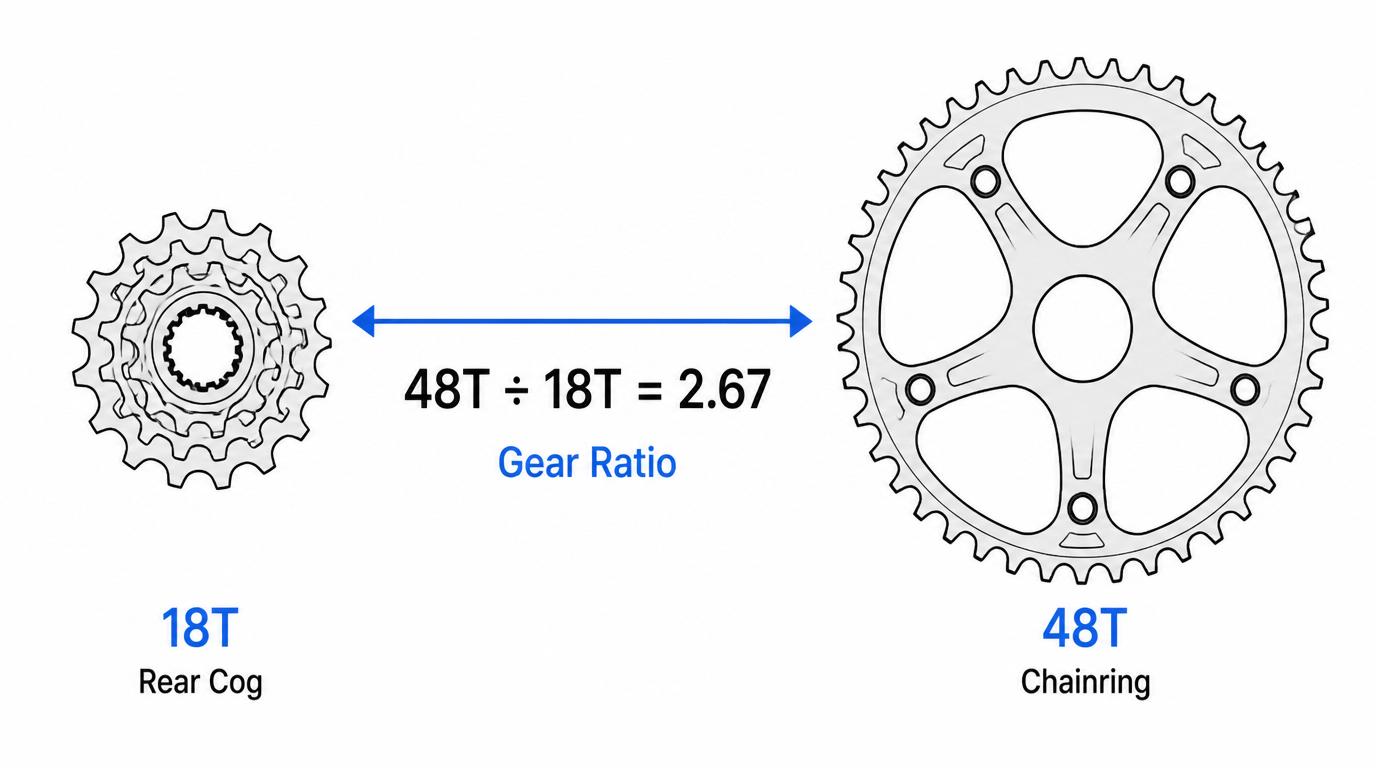
Gear Ratio: The ratio between the front chainring and the rear cog. A ratio of 3.0 means the chainring has exactly 3 times more teeth than the cog — and as a result, the rear wheel completes 3 full rotations for every pedal revolution.
Gear Inches: A traditional measurement representing the mechanical advantage of a gear combination. Originally used to compare modern geared bikes to penny-farthing bicycles. Higher gear inches = harder gear, more speed per pedal stroke.
Development (meters): The distance your bike travels for every full pedal revolution. Useful for comparing gearing across bikes with different wheel sizes — two bikes can have the same gear ratio but different development if the wheels differ in size.
Wheel Size: Gear ratio itself is purely the relationship between chainring and cog teeth — wheel size plays no role in that calculation. However, Gear Inches and Development both depend on how large your wheel is, because a bigger wheel covers more ground per rotation. That is why wheel size is required as a separate input.
For Climbing: Shift to a lower gear (smaller chainring or larger cog), gear ratios (1.5–2.5), when cadence drops and legs feel heavy — typically on climbs, into headwinds, or when starting from a stop. Lower ratios provide easier pedaling for steep ascents.
For Flat Terrain: Shift to a mid-range gear (larger chainring or smaller cog), gear ratios (2.5–3.5), when you want to maintain a steady pace on even ground. Mid-range ratios suit most riders for everyday cycling.
For High Speed: Shift to a higher gear (larger chainring or smallest cog), gear ratios (3.5+), when you are spinning too fast with little resistance — on descents, with a tailwind, or when sprinting. Higher ratios are used by sprinters and for descents.
A good target cadence for most cyclists is 80–100 RPM. If you find yourself significantly above or below that range, it is time to shift.
Take a rider on a 50/34 compact crankset paired with an 11–28 cassette — a common road setup. In the 50×14 combination, the gear ratio is 3.57, meaning the rear wheel spins 3.57 times per pedal stroke. On a 700c wheel, that translates to roughly 8.5 metres of development per revolution — ideal for maintaining 30+ km/h on flat tarmac at a comfortable 85 RPM cadence.
Switch to the 34×28 combination on the same bike, and the ratio drops to 1.21 — just 2.9 metres per revolution. This is the gear a rider shifts into on a steep climb: each pedal stroke moves the bike a fraction of the distance, but requires far less force, letting the legs spin at a sustainable cadence instead of grinding to a near-stop.
This is exactly why gear ratio matters more than raw chainring or cassette size alone — two bikes with completely different components can produce the same ratio, and therefore feel identical underfoot, while two bikes with similar-looking gearing can feel worlds apart if their wheel sizes differ. Our calculator isolates the actual ratio and development so you can compare setups accurately, regardless of brand or component generation.
It depends on terrain and fitness. For flat urban cycling, ratios between 2.5 and 3.5 work well for most riders. For hilly terrain or loaded touring, ratios of 1.5–2.5 make climbing manageable. Track and fixed-gear cyclists often use 2.8–3.2 for a balance between speed and control.
No — gear ratio is determined solely by the number of teeth on the chainring and cog. However, wheel size directly affects Development (distance per pedal stroke). A 29" wheel with a 3.0 ratio covers more ground per revolution than a 26" wheel with the same ratio.
Both measure how hard a gear is, but in different units. Gear inches is a historical imperial measurement, while development gives the actual distance traveled per pedal stroke in metres. Development is more practical for real-world comparisons.
Yes — single-speed and fixed-gear bikes have one chainring and one cog, which is exactly what this calculator is designed for. Enter your chainring teeth, cog teeth, and wheel size to find your ratio, gear inches and development.
There is no single answer — efficiency depends on rider fitness, terrain, and cadence preference. Generally, a combination that lets you maintain 80–100 RPM on your typical terrain is optimal. Use this calculator to compare combinations before changing components.
Development gives theoretical distance per pedal stroke under ideal conditions. Real-world speed also depends on actual cadence, tyre inflation (which slightly affects rolling diameter), and any slippage. The calculator provides a reliable reference point, not an absolute guarantee.
⚠️ Note: Results are estimates based on standard gear ratio formulas and nominal wheel diameters. Actual development may vary slightly depending on tyre inflation and exact tyre dimensions. Always verify your setup on the bike before making component changes.


