Calculate the correct chain length for your bicycle based on your drivetrain setup
Calculating the correct chain length is essential for smooth gear shifting, efficient pedaling, and prolonging the life of your drivetrain.
The most widely used method is the Shimano chain length formula. It uses the chainstay length and the number of teeth on your largest front chainring and largest rear cog.
1. Chainstay Length: The distance between the center of the bottom bracket and the rear axle.
2. Largest Front Chainring: The front gear with the most teeth.
3. Largest Rear Cog: The rear gear with the most teeth.
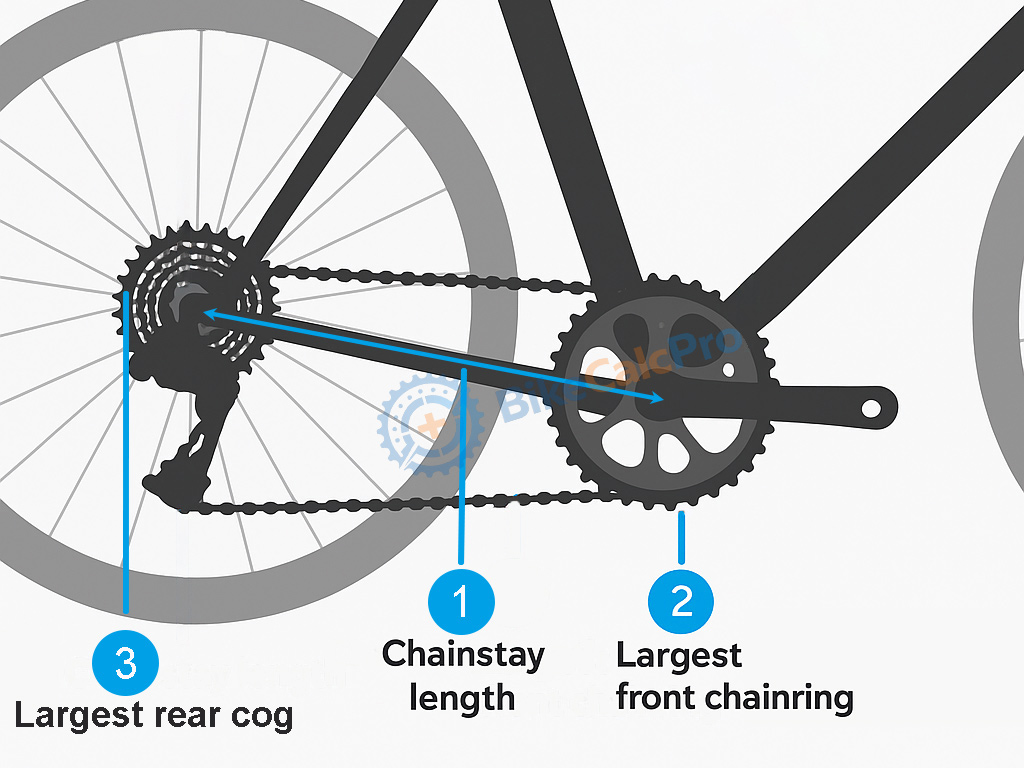
The Shimano formula calculates the minimum chain length needed to reach the largest front chainring and the largest rear cog at the same time — the combination that puts the most tension on the chain. The result is always rounded up to the nearest even number, because chains are made of pairs of inner and outer links.
Formula: Links = (2 × chainstay in inches) + (front teeth + rear teeth) ÷ 4 + 1, rounded up to the nearest even number.
An incorrectly sized chain causes poor shifting, chain drops, and drivetrain damage. Too short — the derailleur cannot reach the largest gears. Too long — the chain sags and bounces, causing skipping and premature wear on your cassette and chainrings.
Take a mountain bike with a 440 mm chainstay, a 32T chainring, and a 51T largest cog (a common modern 1x12 setup). The Shimano formula gives: (2 × 17.3 in) + (32 + 51) ÷ 4 + 1 = 34.6 + 20.75 + 1 ≈ 56.4, rounded up to 58 links. Install a chain with only 56 links — just one pair short — and the derailleur cannot physically reach the largest 51T cog; the chain runs out of slack and either jams the drivetrain or snaps the derailleur hanger under load on a climb.
Go too far the other way and add 4 extra links beyond the correct count, and the chain sags noticeably in the smaller gear combinations. On rough trail terrain, that slack lets the chain bounce against the chainstay, accelerating wear and increasing the risk of it dropping off the chainring entirely on a hard bump.
This is also why full-suspension bikes need 1–2 extra links beyond the standard formula result: as the rear suspension compresses, the effective chainstay length changes slightly, and a chain sized for the static geometry alone can run out of slack mid-travel.
Yes. The Shimano chain length formula works for road bikes, mountain bikes, hybrid bikes, and city bikes. The only exception is full-suspension mountain bikes, which need 1–2 extra links to accommodate suspension travel. The installation tips shown after your result already remind you of this.
Always round up to the nearest even number. Chains consist of alternating inner and outer link pairs, so they can only close correctly on an even count. The calculator handles this automatically — it always returns an even result.
Use a tape measure or rigid ruler. Measure from the center of the bottom bracket axle to the center of the rear wheel axle. On most adult bikes this falls between 400 and 460 mm. You can also find this measurement in your bike manufacturer's geometry chart — chainstay length is always listed there.
On a 1x setup (a single chainring at the front), your largest front chainring is simply your only chainring. Enter that tooth count. The formula works the same way regardless of how many chainrings your bike has.
Most chains last between 1,500 and 3,000 km depending on riding conditions, lubrication, and drivetrain quality. Use a chain wear indicator tool to check for stretch. Replacing a worn chain on time protects your cassette and chainrings from accelerated wear, saving money in the long run.
⚠️ Note: Results from this calculator are estimates based on the standard Shimano chain length formula. Always verify chain tension and derailleur alignment after installation. Actual requirements may vary depending on frame geometry, derailleur model, and chainline. When in doubt, consult a qualified bike mechanic.


