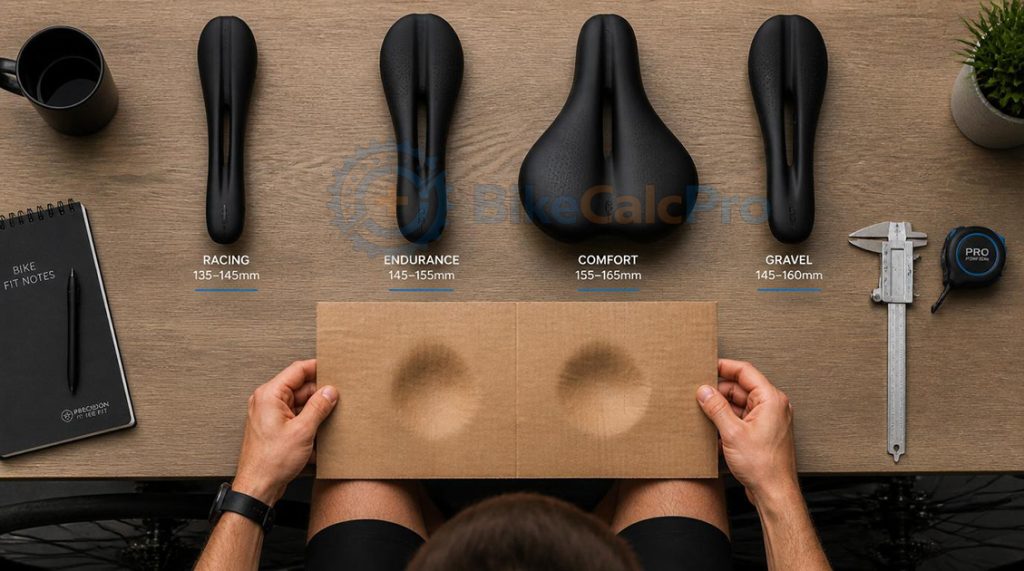
Saddle discomfort is one of the most common complaints among cyclists — and one of the most fixable. In the vast majority of cases, the problem is not that you need to “get used to” the saddle. It is that you are riding on the wrong width, shape, or padding for your anatomy and riding style.
This guide walks you through how to measure what actually matters — your sit bone width — and how to translate that into a saddle choice that works for your body and the way you ride.
Table of Contents
- Why Saddle Width and Shape Matter
- Understanding Sit Bones
- How to Measure Your Sit Bone Width
- Saddle Width Chart by Sit Bone Measurement
- How to Use a Saddle Size Calculator
- Saddle Shape: Flat vs Curved vs Waved
- Saddle Width by Riding Position
- Padding, Cutouts, and Materials
- How to Test a New Saddle
- Common Mistakes to Avoid
- FAQ
Why Saddle Width and Shape Matter
A saddle is the primary contact point that supports your body weight while riding. When it is the wrong width or shape, your body compensates in ways that cause real problems:
- Numbness and tingling — Pressure on soft tissue and nerves, often from a saddle that is too narrow or has a shape that does not match your riding position
- Chafing and saddle sores — Often caused by excessive movement on a saddle that does not properly support your sit bones, forcing you to shift around constantly
- Lower back pain — Can result from a saddle shape that does not match your pelvic rotation in your riding position
- Reduced power output — Constant micro-adjustments to relieve discomfort waste energy and disrupt your pedalling rhythm
The right saddle should support your sit bones (the bony points at the base of your pelvis) directly, with the soft tissue in between experiencing minimal pressure. This is a matter of anatomy and geometry, not toughness or “breaking in” a saddle.
Understanding Sit Bones
Your sit bones (technically the ischial tuberosities) are the two bony points at the bottom of your pelvis that bear your weight when sitting. On a bike, these are meant to be the primary support structure — not the soft tissue between them.
Sit bone width varies significantly between individuals, and is not strictly correlated with height, weight, or even gender, although on average, the difference in pelvic structure means many (though not all) female cyclists have wider sit bone spacing than male cyclists of similar height. This is why saddle manufacturers produce dedicated width ranges and gender-specific models — but the only reliable way to know your fit is to measure your own sit bone width directly.
How to Measure Your Sit Bone Width
This is the single most important measurement for choosing the correct saddle width. It takes about five minutes and requires no special equipment.
What You Need
- A piece of corrugated cardboard (at least 30 × 30 cm)
- A flat, hard chair or stool
- A ruler or tape measure
- A flat surface to place the cardboard on the floor
Step-by-Step
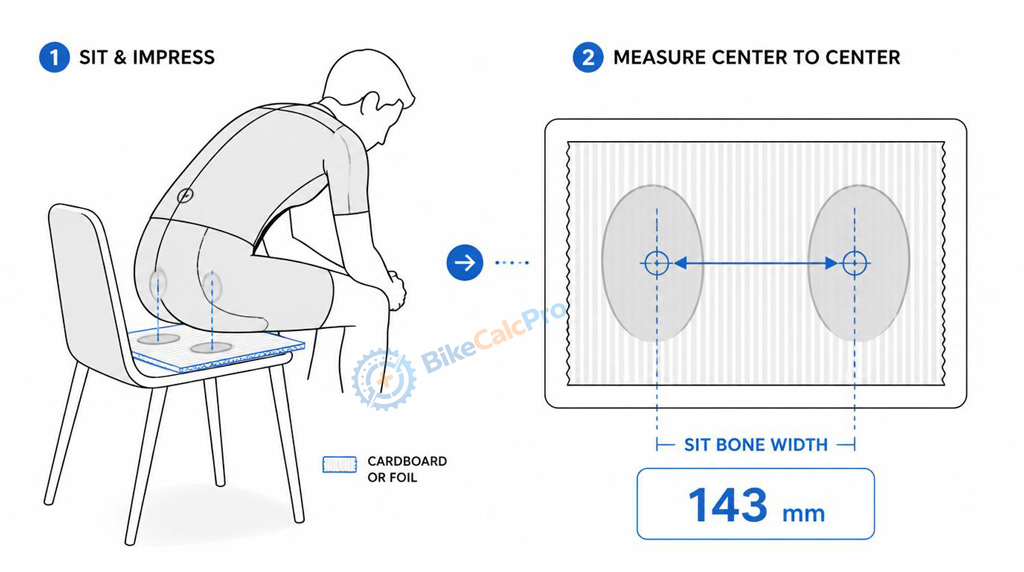
- Place the cardboard on the floor against a wall or on a hard chair seat
- Sit down on the cardboard with your knees bent at roughly a 90-degree angle, as if sitting on a normal chair — this position approximates your seated riding posture
- Rock slightly side to side for a few seconds, then sit still and lean slightly forward, mimicking a riding position
- Stand up carefully without smudging the cardboard
- Locate the two indentations left by your sit bones — they will appear as the deepest, most defined impressions, roughly 8–14 cm apart
- Measure the distance between the centre points of the two indentations in millimetres
Alternative Method: Sit Bone Measurement at a Bike Shop
Many bike shops and saddle manufacturers (Specialized, Trek/Bontrager, and others) offer a sit bone measurement tool — typically a gel-pad device you sit on briefly, which gives a precise digital readout. This is faster and slightly more accurate than the cardboard method, and it is free at most shops that sell saddles.
Tip: Take the measurement wearing your normal cycling shorts, not bare, as padding and seams can slightly affect how you sit.
Saddle Width Chart by Sit Bone Measurement
Once you have your sit bone width, add 20–30 mm to determine your recommended saddle width. This extra margin accounts for slight side-to-side movement and ensures your sit bones remain supported throughout the pedal stroke, not just when sitting still.
| Sit Bone Width | Recommended Saddle Width |
|---|---|
| 90–100 mm | 130–140 mm |
| 100–110 mm | 140–150 mm |
| 110–120 mm | 150–160 mm |
| 120–130 mm | 160–170 mm |
| 130mm+ | 170mm+ |
Note: This chart assumes a road or performance riding position (more forward lean). Riders in a more upright position need a slightly wider saddle relative to their sit bone width — see the riding position section below.
How to Use a Saddle Size Calculator
A calculator helps translate your sit bone measurement into a precise recommendation while also accounting for your riding style.
Our Saddle Size Calculator takes into account:
- Your sit bone width measurement
- Your typical riding position (aggressive/road, neutral, upright/commuter)
- Your primary discipline (road, gravel, MTB, commuting)
How to get the most accurate result:
- Measure your sit bone width using the cardboard method or a bike shop fitting tool
- Be honest about your typical riding position — a more upright position needs a wider saddle than an aggressive, forward-leaning position
- Use the result as a starting width range, then check specific saddle models within that range, as shape also matters significantly (see below)
Saddle Shape: Flat vs Curved vs Waved
Width is only one half of saddle fit. Shape — specifically, the saddle’s profile from nose to tail — determines how well it supports your body as you move and rotate your pelvis while riding.
Flat Profile Saddles
Flat saddles have minimal curvature from front to back. They allow more freedom of movement, which suits riders who frequently shift position — common among gravel and endurance riders who change posture often over long rides. They also work well for riders with a more aggressive, rotated-forward pelvic position, as a flat profile does not create pressure points when the pelvis is tilted.
Curved (Traditional) Profile Saddles
Curved saddles cradle the rider more, with a defined rise toward the nose and tail. They suit riders who maintain a more consistent seated position, providing more defined support but less freedom to shift around. These are common on traditional road racing saddles.
Waved Profile Saddles
Waved saddles have a more complex profile with multiple curves, designed to support the rider at specific points while relieving pressure elsewhere. These are often marketed for power-focused riders who want support without unwanted movement.
Which Shape Should You Choose?
| Riding Style | Recommended Shape |
|---|---|
| Aggressive road racing position | Flat or waved |
| Endurance road / gravel (frequent repositioning) | Flat |
| Time trial / triathlon (very forward, rotated pelvis) | Flat, often with a cutout (see below) |
| Upright commuting / touring | Curved |
| Mountain biking (frequent standing, less seated time) | Shape matters less; durability and width matter more |
Saddle Width by Riding Position
Your riding position changes how your pelvis rotates, which in turn changes how your sit bones contact the saddle — and therefore what width and shape work best.
Aggressive / Racing Position
A more forward lean rotates your pelvis forward, narrowing the effective contact area of your sit bones on the saddle. Riders in this position often need a narrower saddle than their raw sit bone measurement chart would suggest, because the rotated pelvis brings the sit bones closer together relative to the saddle surface.
Neutral / Endurance Position
A moderate forward lean, common on endurance road bikes and gravel bikes, generally matches the standard width chart above without major adjustment.
Upright / Commuter Position
An upright posture keeps the pelvis more vertical, meaning your full sit bone width (plus margin) bears down directly on the saddle. Riders in this position often need a wider saddle than the standard chart suggests — sometimes by 10–20 mm more.
Padding, Cutouts, and Materials
Padding Thickness
More padding is not automatically more comfortable. Excessive padding can compress unevenly and create pressure points, particularly on longer rides. Race-oriented saddles tend to use firmer, thinner padding that maintains its shape and supports the sit bones precisely. Comfort and touring saddles use more generous padding for shorter-duration upright riding.
Cutouts and Channels
Many modern saddles feature a central cutout or pressure-relief channel, designed to reduce pressure on soft tissue and improve blood flow, particularly important for riders who experience numbness. These are especially common and beneficial for riders in aggressive or time-trial positions, where pelvic rotation increases pressure on this area.
Materials
- Saddle shell — Carbon shells flex slightly and save weight; nylon/composite shells are more affordable and slightly more forgiving
- Saddle rails — Steel rails are durable and affordable; titanium and carbon rails save weight at a higher price point
- Cover material — Synthetic leather is durable and weather-resistant; genuine leather (less common today) moulds to the rider over time but requires more maintenance
How to Test a New Saddle
Saddle fit is highly individual, and even careful measurement does not guarantee the first saddle you try will feel perfect. Here is how to test effectively:
Use a Demo Program If Available
Many bike shops and saddle manufacturers (Specialized’s “Body Geometry” fit system, for example) offer demo saddles you can trial for a set period before committing to a purchase.
Give It Real Time
A genuinely ill-fitting saddle usually causes discomfort within the first ride or two. However, a borderline saddle may take 3–5 rides to assess fairly, as your body adjusts slightly to any new saddle shape.
Check Multiple Positions
Test the saddle in the different positions you actually ride in — seated climbing, standing climbing, descending, and sprinting (if relevant to your riding) — not just steady-state cruising.
Pay Attention to Specific Symptoms
| Symptom | Likely Cause |
|---|---|
| Numbness | Saddle too narrow, or lacking a cutout for your position |
| Chafing on the sides | Saddle too wide for your riding position |
| Pain at the front (perineum) | Nose too wide, or saddle tilted nose-down |
| Pain at the sit bones directly | Insufficient padding, or saddle genuinely too narrow |
| Sliding forward constantly | Saddle tilted nose-down, or shape mismatch |
Common Saddle Selection Mistakes to Avoid
Mistake 1: Choosing Width Based on Comfort Alone, Without Measuring
A saddle that feels comfortable when sitting on it in a shop (upright, stationary) often feels very different after 30 minutes of riding in your actual riding position. Always start with a sit bone measurement.
Mistake 2: Assuming Wider Is Always More Comfortable
A saddle wider than your actual sit bone width plus margin can cause chafing on the inner thighs from rubbing against the saddle’s edges, especially in an aggressive riding position.
Mistake 3: Ignoring Riding Position When Choosing Width
The same sit bone measurement can call for different saddle widths depending on whether you ride upright or aggressively. Always factor in your actual riding posture, not just the raw measurement.
Mistake 4: Expecting to “Break In” a Genuinely Wrong-Sized Saddle
Some saddles do soften slightly with use, particularly leather ones. But a saddle that is fundamentally the wrong width or shape for your anatomy will not become comfortable through persistence alone — it needs to be replaced with the correct size.
Mistake 5: Not Checking Saddle Tilt Before Blaming the Saddle Itself
Many saddle discomfort issues are actually caused by incorrect saddle angle, not the saddle itself. Before replacing a saddle, ensure it is level (or adjusted by no more than 1–2 degrees) and that saddle height and fore-aft position are correctly set.
FAQ
How do I know what saddle width I need?
Measure your sit bone width using the cardboard method or a bike shop fitting tool, then add 20–30 mm to find your recommended saddle width. Use our Saddle Size Calculator for a personalised recommendation that also factors in your riding position.
Does saddle width matter more than saddle padding?
Yes. Width and shape determine whether your sit bones are properly supported, which is the foundation of saddle comfort. Padding affects comfort at the margins, but no amount of padding will fix a saddle that is the wrong width for your anatomy.
Why does my saddle cause numbness?
Numbness typically results from pressure on soft tissue and nerves, often caused by a saddle that is too narrow for your sit bones or lacks a pressure-relief cutout suited to your riding position. Saddle tilt (nose pointed too far down) can also contribute to numbness.
Are men's and women's saddles really different?
Many saddle ranges are marketed by gender because average pelvic width differs somewhat between male and female cyclists, but this is a generalisation, not a rule. The only reliable approach is to measure your individual sit bone width rather than choosing based on gender labels alone.
Should I choose a saddle with a cutout?
Cutout saddles can help reduce pressure on soft tissue, particularly for riders in aggressive or time-trial positions where pelvic rotation increases pressure in this area. They are not strictly necessary for every rider, but many find them beneficial, especially on longer rides.
How often should I replace my bike saddle?
There is no fixed mileage interval for saddle replacement — unlike chains or tires, saddles do not wear out in a measurable way under normal use. Replace your saddle if you experience persistent discomfort despite correct sizing, if the cover or padding becomes visibly damaged, or if your riding position or style changes significantly.
Summary
Saddle comfort comes down to matching width and shape to your individual anatomy and riding style — not toughing out discomfort or relying on extra padding. The key steps:
- Measure your actual sit bone width with the cardboard method
- Add 20–30 mm to find your recommended saddle width
- Match the saddle shape to your riding position (flat for aggressive/movement, curved for steady upright riding)
- Adjust your expectation of width based on whether you ride upright or aggressively
- Test before committing, ideally through a demo program
Ready to find your exact saddle size? Use our Saddle Size Calculator →