
Enter Your Measurements
Recommended Saddle Width
Calculate the ideal saddle width based on your sit bone measurements for optimal comfort and support
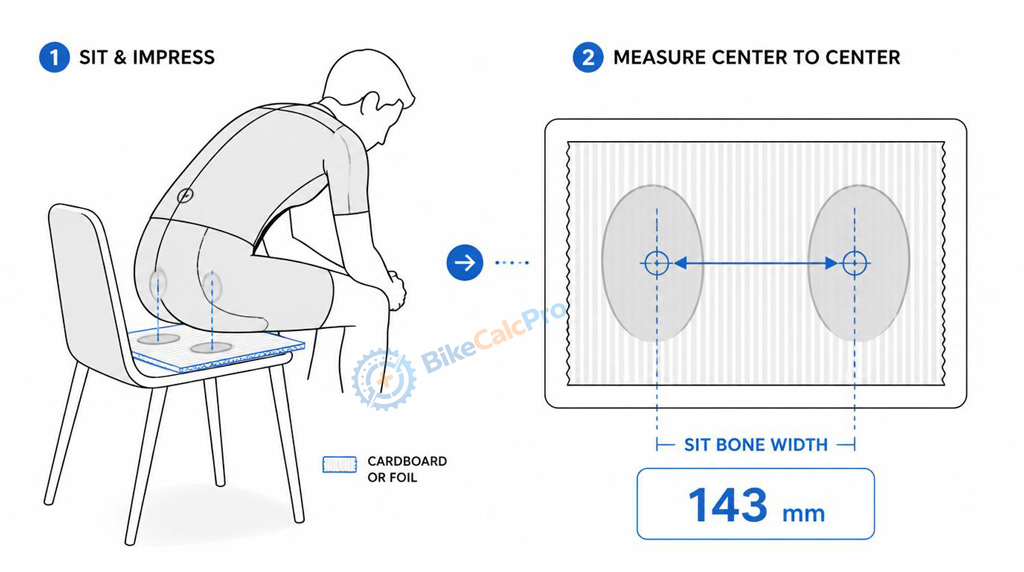
Most people measure between 100–145 mm. Men average around 120 mm, women around 130 mm — though individual variation is significant and the calculator uses your actual measurement, not averages.
In an upright position your full sit bone width contacts the saddle, so you need a wider saddle. As your position becomes more aggressive (forward lean), your pelvis rotates and less of the sit bone contacts the saddle — a narrower saddle prevents inner-thigh chafing.
The recommended width is determined entirely by sit bone measurement — not by gender. Women-specific models offer different padding density, cutout geometry, and nose width at the same recommended width. If you find the recommendation uncomfortable, a women-specific model at the same size is worth trying.
This calculator gives a reliable starting point. For persistent discomfort, numbness, or if you are training at a high level, a professional bike fit is recommended — a fitter can account for flexibility, pelvic tilt, and cleat position beyond what any formula captures.
Take a rider with a 125 mm sit bone measurement riding in a moderate position. The calculator typically recommends adding roughly 15–20 mm of clearance, landing on a 140–145 mm saddle. If that same rider instead picks a 130 mm saddle — just 10–15 mm narrower — the sit bones no longer rest fully on the saddle's support area. The rider's weight shifts onto soft tissue at the edges, which over a long ride produces exactly the kind of numbness and discomfort that's often mistaken for a saddle shape problem rather than a width problem.
The riding position adjustment compounds this. The same 125 mm sit bone measurement in an aggressive race position might call for only 120–125 mm, because the forward pelvic rotation shifts weight off the sit bones onto the perineal area — a wider saddle in this position causes inner-thigh chafing on every pedal stroke, since the saddle's wide edges interfere with leg movement before the sit bones even need the extra support.
This is why two riders with identical sit bone measurements but different riding styles — one upright commuter, one aggressive road racer — can need saddles 20 mm apart in width despite having the exact same anatomy.
Yes. Select Moderate for a relaxed gravel position or Aggressive if you ride in a flatter, race-oriented position. The sit bone measurement itself is bike-agnostic — the riding position adjustment accounts for the different pelvic angle.
There is no fixed interval. Replace a saddle when the shell cracks, the padding compresses noticeably (loses its shape), or the cover tears and exposes foam. High-quality saddles can last many years with normal use. If comfort declines without visible damage, a professional fit is a better first step than an immediate replacement.
Go with the narrower of the two. A saddle that is slightly too narrow is generally preferable to one that is slightly too wide — excess width causes inner-thigh chafing during pedalling. The ±5 mm tolerance in the tips above covers this overlap.
Indirectly, yes. If your saddle is set too low, your pelvis rocks side to side and a wider saddle may feel more stable — masking a fit problem. Set your saddle height correctly first (use our Saddle Height Calculator), then measure sit bones for an accurate width recommendation.
Round up to the wider size. Most saddle manufacturers produce widths in 5 mm increments (130, 135, 140, 145 mm). If your recommendation lands between two options, the wider one is the safer choice — it ensures full sit bone support without pressure on soft tissue.


