Gear ratios confuse a lot of cyclists — and it is easy to see why. Between chainrings, cassettes, gear inches, and development metres, the terminology alone can feel overwhelming. But understanding gear ratio is one of the most useful pieces of knowledge you can have as a cyclist, whether you are climbing a mountain pass, setting up a single-speed commuter, or trying to understand why your new bike feels “harder” or “easier” than your old one.
This guide breaks gear ratio down into plain language, shows you exactly how to calculate it, and explains how to use that knowledge to ride better.
Table of Contents
- What Is Gear Ratio?
- How to Calculate Gear Ratio
- Gear Inches vs Gear Ratio vs Development
- Why Gear Ratio Matters
- Typical Gear Ratios by Riding Style
- How to Use a Gear Ratio Calculator
- Understanding Your Gear Range
- Cadence and Gear Ratio
- Common Mistakes to Avoid
- FAQ
What Is Gear Ratio?
At its simplest, gear ratio is the relationship between how many times your pedals turn and how many times your rear wheel turns.
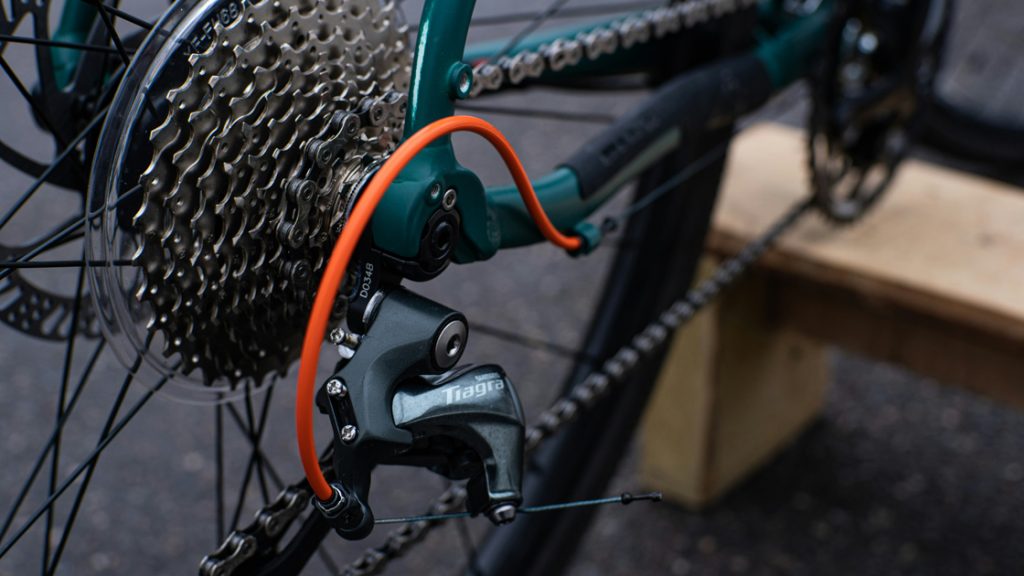
Every time you complete one full pedal revolution, your rear wheel turns a certain number of times — determined by the size of your front chainring and rear cog (or cassette sprocket).
- A high gear ratio (big chainring, small cog) means the rear wheel turns many times per pedal stroke. This is harder to pedal but covers more ground — ideal for flat roads and descents.
- A low gear ratio (small chainring, big cog) means the rear wheel turns fewer times per pedal stroke. This is easier to pedal but covers less ground per revolution — ideal for climbing.
Think of it like the gears in a car: first gear gets you moving with less effort but lower speed, while higher gears let you cruise faster with less pedal effort per unit of distance, but require more force to get there.
How to Calculate Gear Ratio
The basic formula for gear ratio is straightforward:
Gear Ratio = Number of teeth on chainring ÷ Number of teeth on rear cog
Example Calculation
If you are riding with a 50-tooth chainring and a 17-tooth rear cog:
Gear Ratio = 50 ÷ 17 = 2.94
This means for every one full turn of the pedals, your rear wheel turns 2.94 times.
A Quick Reference Example Table
| Chainring | Rear Cog | Gear Ratio | Feel |
|---|---|---|---|
| 34 | 28 | 1.21 | Very easy (climbing) |
| 34 | 17 | 2.00 | Easy-moderate |
| 50 | 17 | 2.94 | Moderate-hard |
| 50 | 11 | 4.55 | Very hard (descending/sprinting) |
The higher the number, the harder the gear is to pedal, but the more distance you cover per pedal stroke.
Gear Inches vs Gear Ratio vs Development
Cyclists use three related but different terms. Understanding the difference helps you compare bikes and components accurately.
Gear Ratio
The simple division of chainring teeth by cog teeth, as shown above. This is a dimensionless number — it has no units. It is useful for comparing gears on the same bike but does not account for wheel size, so it cannot be used to compare gearing across different bike types (a road bike vs a 29er MTB, for example).
Gear Inches
This measurement does account for wheel size, making it useful for comparing gearing across different bikes.
Gear Inches = Gear Ratio × Wheel Diameter (inches)
A road bike with 700c wheels (approximately 27 inches in diameter including tire) running a 2.94 gear ratio would have:
Gear Inches = 2.94 × 27 = 79.4 inches
This historical unit comes from the days of penny-farthing bicycles, where the front wheel diameter directly determined how far you travelled per pedal revolution.
Development (Metres per Pedal Revolution)
Development is the metric system equivalent, expressing how far the bike travels (in metres) for one full pedal revolution.
Development = Gear Ratio × Wheel Circumference (metres)
For a 700c wheel with a circumference of approximately 2.105 metres and a gear ratio of 2.94:
Development = 2.94 × 2.105 = 6.19 metres
This means each pedal revolution moves the bike forward 6.19 metres in this gear.
Which Should You Use?
| Metric | Best For |
|---|---|
| Gear Ratio | Quick comparison within the same bike/wheel size |
| Gear Inches | Comparing across different wheel sizes (imperial) |
| Development | Comparing across different wheel sizes (metric) |
For most practical purposes — choosing chainrings and cassettes for your riding style — gear ratio alone is sufficient. Gear inches and development become useful when comparing across very different bike setups.
Why Gear Ratio Matters
Understanding gear ratio helps you in several practical situations:
Choosing the Right Setup for Your Terrain
If you live somewhere hilly and your current gearing tops out at a ratio that still feels too hard on climbs, you know you need a smaller chainring or a bigger cassette cog — not just “more gears.”
Comparing Bikes Before Buying
Two bikes might both have “11-speed” groupsets, but if one has a compact 50/34 chainset and the other has a standard 53/39, their gear ranges — and how they feel on hills — are meaningfully different.
Understanding Cadence and Effort
Gear ratio directly affects how fast your legs need to spin (cadence) to maintain a given speed. Get the gearing wrong for your riding style and you will either spin out (cadence too high, no power) or grind (cadence too low, knee strain).
Diagnosing “This Bike Feels Harder” Complaints
If a new bike feels harder to pedal than your old one at the same apparent gear, the cause is often a different gear ratio — not your fitness.
Typical Gear Ratios by Riding Style
Different disciplines favour different gear ratio ranges based on terrain and riding demands.
Road Cycling — Flat to Rolling Terrain
| Chainring Setup | Typical Cassette | Gear Ratio Range |
|---|---|---|
| Standard (53/39) | 11-28 | 1.39 – 4.82 |
| Compact (50/34) | 11-32 | 1.06 – 4.55 |
| Compact (50/34) | 11-28 | 1.21 – 4.55 |
Compact chainsets (50/34) have become the standard choice for most recreational and even competitive road cyclists, offering an easier climbing gear without sacrificing much top-end speed.
Road Cycling — Mountainous Terrain
For riders who frequently tackle steep climbs, a wider range cassette (11-32 or 11-34) paired with a compact or sub-compact chainset (48/32 or 46/30) provides significantly easier climbing gears.
Gravel Cycling
Gravel setups typically favour a wide gear range to handle both fast gravel roads and steep, loose climbs:
| Setup Type | Typical Range | Gear Ratio Range |
|---|---|---|
| 1x (single chainring) | 40t with 10-42 cassette | 0.95 – 4.00 |
| 2x (double chainring) | 48/31 with 11-34 cassette | 0.91 – 4.36 |
Mountain Biking
Modern MTB drivetrains have moved almost entirely to 1x (single chainring) setups with very wide-range cassettes:
| Setup Type | Typical Range | Gear Ratio Range |
|---|---|---|
| 1×12 (common modern setup) | 32t with 10-52 cassette | 0.62 – 3.20 |
| 1×11 (older standard) | 32t with 11-42 cassette | 0.76 – 2.91 |
The very low gear ratios (below 1.0) are essential for steep technical climbs where control and traction matter as much as power.
Single-Speed and Fixed Gear
Single-speed riders must choose one gear ratio that works across all the terrain they expect to ride. Common urban single-speed setups use ratios between 2.5 and 3.0 — a compromise between accelerating from stops and maintaining reasonable speed.
How to Use a Gear Ratio Calculator
Manually calculating every combination of chainring and cassette cog is tedious. Our Gear Ratio Calculator does this instantly.
Enter your setup and the calculator returns:
- The gear ratio for any chainring/cog combination
- Gear inches and development for cross-comparison
- Your full gear range across all combinations (useful for understanding your easiest and hardest gears)
- Speed at a given cadence for any gear combination
How to get the most accurate result:
- Enter the exact tooth count for your chainring(s) — check the small numbers stamped on the chainring itself
- Enter the tooth count for each cog on your cassette — usually printed on the largest and smallest cogs, with the full range listed by the manufacturer
- Enter your wheel size (700c, 650b, 29″, 27.5″, etc.) for accurate gear inches and development figures
Understanding Your Gear Range
Your gear range is the spread between your easiest gear (lowest ratio) and your hardest gear (highest ratio). This is often expressed as a percentage.
Gear Range % = (Largest gear ratio ÷ Smallest gear ratio) × 100
Why Range Matters More Than Individual Gears
Two riders might have very different gear setups but similar overall capability if their range covers the terrain they ride. A wide-range cassette paired with a single chainring (1x) can offer comparable range to a traditional double chainring setup, with the trade-off of larger jumps between gears.
Gaps Between Gears
A cassette with closely spaced cogs (e.g., 11-12-13-14-15-17-19-21-23-25) gives you fine control over cadence — useful for racing where small adjustments matter. A wide-range cassette (e.g., 10-12-14-16-18-21-24-28-32-36-42-50) has bigger jumps between gears, trading fine control for overall range — useful for varied terrain where covering the range matters more than precision.
Cadence and Gear Ratio
Cadence — how fast you spin the pedals, measured in revolutions per minute (RPM) — and gear ratio work together to determine your speed.
Speed = Cadence × Gear Ratio × Wheel Circumference
This means the same speed can be achieved with a high cadence in a low gear, or a low cadence in a high gear. Most cyclists find an efficient cadence range of 80–100 RPM for road cycling and 60–90 RPM for mountain biking, though this varies by individual physiology and riding style.
Practical Application
If you find yourself constantly pedalling above 100 RPM and still not going fast enough, you may need a higher gear ratio. If you find yourself grinding below 60 RPM on flat terrain, you may need a lower gear ratio or to shift down more proactively.
Common Gear Ratio Mistakes to Avoid
Mistake 1: Confusing “More Gears” with “Better Range”
An 11-speed cassette is not automatically better than a 10-speed cassette for climbing. What matters is the largest cog size, not the number of gears. A 10-speed 11-42 cassette has a wider range than an 11-speed 11-28 cassette.
Mistake 2: Choosing Gearing Based on Flat-Ground Testing
If you test ride a bike only on flat ground, you will not discover whether the gearing suits the climbs in your local area. Always consider your typical terrain, not just your typical test ride.
Mistake 3: Ignoring Chain Compatibility
Wide-range cassettes (especially 1x setups with 10-50 or 10-52 spreads) require a derailleur and chain specifically rated for that range. Mixing incompatible components can cause poor shifting or chain drops.
Mistake 4: Cross-Chaining
Running the smallest chainring with the smallest cassette cog (or largest with largest) creates an extreme chain angle that increases wear and reduces shifting efficiency. Try to keep the chainline reasonably straight by using the big chainring with smaller-to-middle cogs, and the small chainring with middle-to-larger cogs.
Mistake 5: Assuming Gear Ratio Numbers Translate Directly to “Difficulty”
Gear ratio tells you the mechanical relationship, but actual pedalling effort also depends on terrain gradient, wind, your fitness, and bike weight. Use gear ratio as a planning tool, not an absolute predictor of how hard a ride will feel.
FAQ
What is a good gear ratio for climbing?
For steep climbs, a gear ratio below 1.5 is generally recommended for most riders, with very steep gradients (10%+) often requiring ratios closer to 1.0 or lower. Compact chainsets (50/34) paired with a wide-range cassette (11-32 or larger) provide accessible climbing gears for most road cyclists.
How do I calculate my bike's gear ratio?
Divide the number of teeth on your chainring by the number of teeth on your rear cog. For example, a 50-tooth chainring with a 17-tooth cog gives a gear ratio of 2.94. Use our Gear Ratio Calculator to calculate this instantly for any combination.
What is the difference between gear ratio and gear inches?
Gear ratio is a simple division of chainring teeth by cog teeth, with no unit. Gear inches multiplies that ratio by the wheel diameter, making it possible to compare gearing across bikes with different wheel sizes — useful when comparing, for example, a road bike to a mountain bike.
Is a higher gear ratio better?
Not universally. A higher gear ratio means more speed per pedal revolution but requires more force to turn the pedals. The "better" ratio depends entirely on the terrain and your goals — higher ratios suit flat, fast riding, while lower ratios suit climbing and technical terrain.
Why does my new bike feel harder to pedal than my old one?
This is usually explained by a different gear ratio, not a change in your fitness. Compare the chainring and cassette specifications between the two bikes — a bike with a larger chainring or smaller cassette cogs will require more effort to pedal at the same speed.
What gear ratio should I use for a single-speed bike?
Most urban single-speed riders use a gear ratio between 2.5 and 3.0, balancing the ability to accelerate from stops with reasonable cruising speed. Riders in hillier areas often choose lower ratios (2.0–2.5) for easier climbing, accepting a lower top speed in exchange.
Summary
Gear ratio is simply the relationship between your pedal revolutions and your wheel revolutions — and once you understand the calculation, choosing the right gearing for your riding becomes far less intimidating.
Key takeaways:
- Gear Ratio = Chainring teeth ÷ Cog teeth
- Higher ratio = harder to pedal, more distance per stroke
- Lower ratio = easier to pedal, less distance per stroke
- Gear range (not gear count) determines how well your bike handles varied terrain
- Match your gearing to your terrain, not just your fitness level
Ready to calculate your exact gear ratios? Use our Gear Ratio Calculator →