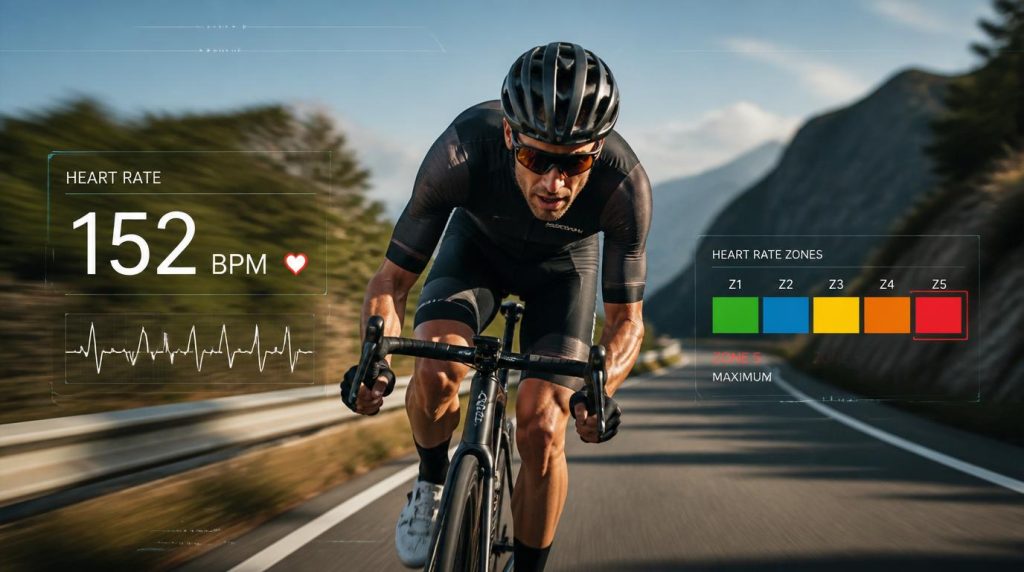
Heart rate is the most accessible training metric in cycling — every smartwatch, chest strap, and even some bike computers can measure it, with no need for a power meter or specialised equipment. Used correctly, heart rate zones give you a reliable way to structure training intensity, even without more expensive tools.
This guide explains how heart rate zones work, how to calculate yours, and how to use them effectively — along with an honest look at where heart rate has limitations compared to power.
Table of Contents
- Why Heart Rate Zones Matter
- How to Find Your Maximum Heart Rate
- How to Calculate Your Heart Rate Zones
- The 5 Heart Rate Training Zones Explained
- Heart Rate Reserve Method (More Accurate)
- Lactate Threshold Heart Rate (Most Accurate)
- Heart Rate vs Power: Strengths and Limitations
- Factors That Affect Heart Rate Beyond Fitness
- How to Use Heart Rate Zones in Training
- Common Mistakes to Avoid
- FAQ
Why Heart Rate Zones Matter
Heart rate reflects how hard your cardiovascular system is working to meet the demands of your effort — a useful proxy for overall physiological intensity, particularly for sustained, steady-state efforts.
Training zones based on heart rate allow you to:
- Structure intensity without expensive equipment — a chest strap or wrist-based sensor is far cheaper than a power meter
- Avoid the “moderate intensity rut” — having defined zones makes genuinely easy days and genuinely hard days more deliberate, rather than defaulting to a comfortable middle effort
- Track fitness changes over time — as fitness improves, your heart rate at a given pace or power typically decreases, providing a useful (if imperfect) fitness indicator
- Monitor recovery and overtraining risk — persistently elevated resting or exercise heart rate can be an early indicator of inadequate recovery
How to Find Your Maximum Heart Rate
Heart rate zones are typically calculated as a percentage of your maximum heart rate (Max HR), making an accurate Max HR figure the foundation of the entire system.
Method 1: Age-Based Formula (Least Accurate, Most Convenient)
The widely cited formula:
Max HR = 220 − Age
This formula is convenient but notoriously imprecise for individuals — actual maximum heart rate can vary by 10–20 beats per minute or more from this estimate at the same age, due to genuine physiological variation between individuals.
Method 2: Field Test (More Accurate)
A practical field test, performed when well-rested and ideally with medical clearance if you have any health concerns:
- Warm up thoroughly for 15–20 minutes
- Find a long, gradual climb or perform several maximal efforts on flat ground
- Perform a final all-out effort for 2–3 minutes, pushing to genuine maximal exertion
- Note the highest heart rate reading reached during or immediately after this effort
This approach gets considerably closer to your actual maximum than the age-based formula, though true laboratory maximal testing remains the gold standard for absolute precision.
Method 3: Observed Maximum During Real Riding
Over time, many riders simply note the highest heart rate they have ever recorded during genuinely maximal efforts (hard race finishes, all-out climbs) across their training history. This observed maximum, if recorded during genuinely maximal effort, is often a reasonably reliable figure to use going forward.
Safety note: If you have any underlying heart conditions, are returning to exercise after a significant break, or have any health concerns, consult a doctor before performing maximal heart rate testing.
How to Calculate Your Heart Rate Zones
The simplest and most common method calculates zones as a straightforward percentage of Max HR.
Standard 5-Zone Model (Percentage of Max HR)
| Zone | % of Max HR | Example (Max HR = 180) |
|---|---|---|
| Zone 1 — Recovery | 50–60% | 90–108 bpm |
| Zone 2 — Endurance | 60–70% | 108–126 bpm |
| Zone 3 — Tempo | 70–80% | 126–144 bpm |
| Zone 4 — Threshold | 80–90% | 144–162 bpm |
| Zone 5 — Maximal/Anaerobic | 90–100% | 162–180 bpm |
Calculation Example
For a rider with a Max HR of 185 bpm:
- Zone 2 lower bound: 185 × 0.60 = 111 bpm
- Zone 2 upper bound: 185 × 0.70 = 130 bpm
This straightforward percentage method is widely used and reasonably effective, though it has known limitations compared to the more individualised methods described later in this guide.
The 5 Heart Rate Training Zones Explained
Zone 1 — Recovery (50–60% Max HR)
Very light effort, used for active recovery rides or warm-up/cool-down periods. This intensity promotes blood flow and recovery without adding meaningful training stress.
Zone 2 — Endurance (60–70% Max HR)
The foundation of most cycling training volume. This intensity is sustainable for long durations, develops aerobic base fitness and fat-burning efficiency, and forms the majority of training time in most well-structured plans, including for competitive athletes.
Zone 3 — Tempo (70–80% Max HR)
A moderately hard, “comfortably uncomfortable” intensity. Useful in moderate doses but is also the zone that unstructured riding naturally gravitates toward — too much time here, at the expense of genuine Zone 1/2 and Zone 4/5 work, can limit overall training effectiveness.
Zone 4 — Threshold (80–90% Max HR)
A hard, sustained effort approximately corresponding to what you could hold for 20–60 minutes maximally. Develops the ability to sustain high effort for extended periods — directly relevant to time trials, sustained climbs, and breakaway efforts.
Zone 5 — Maximal/Anaerobic (90–100% Max HR)
Very hard to maximal effort, sustainable only briefly. Develops top-end power, sprint capability, and the ability to handle repeated hard accelerations, such as in criterium racing or steep, punchy climbs.
Heart Rate Reserve Method (More Accurate)
The percentage-of-Max-HR method, while simple, does not account for individual resting heart rate, which varies significantly between people based on fitness level and individual physiology. The Heart Rate Reserve (HRR) method, also called the Karvonen formula, addresses this.
The Karvonen Formula
Target HR = ((Max HR − Resting HR) × Intensity %) + Resting HR
Why This Is More Accurate
Two riders with the same Max HR but very different resting heart rates (say, 50 bpm for a highly aerobically fit rider versus 70 bpm for a less trained rider) have a meaningfully different heart rate reserve to work with. The straightforward percentage-of-Max-HR method treats both riders identically, while the HRR method accounts for this individual difference, generally producing more personalised and accurate zone boundaries.
Calculation Example
For a rider with Max HR of 185 bpm and Resting HR of 55 bpm, calculating the Zone 2 lower bound (60% intensity):
Target HR = ((185 − 55) × 0.60) + 55 = (130 × 0.60) + 55 = 78 + 55 = 133 bpm
Compare this to the simple percentage method’s Zone 2 lower bound for the same Max HR (185 × 0.60 = 111 bpm) — a meaningfully different result, illustrating why the HRR method is generally considered more accurate for individuals with notably high or low resting heart rates relative to average.
How to Measure Resting Heart Rate
Measure first thing in the morning, before getting out of bed, ideally using a chest strap or reliable wrist-based sensor over several mornings to get a stable average, since a single reading can be affected by sleep quality, hydration, or recent stress.
Lactate Threshold Heart Rate (Most Accurate)
The most individually accurate approach to heart rate zones uses Lactate Threshold Heart Rate (LTHR) — the heart rate corresponding to the point where lactate begins accumulating faster than the body can clear it — as the reference point, rather than Max HR.
Why LTHR-Based Zones Are More Accurate
LTHR reflects your actual current aerobic fitness and threshold capacity directly, rather than relying on Max HR, which can remain relatively stable even as fitness changes significantly. This makes LTHR-based zones more responsive to genuine fitness improvements over time.
How to Estimate LTHR Without Lab Testing
A commonly used field test:
- Warm up thoroughly for 15–20 minutes
- Perform a 20-minute maximal sustained effort — as hard as you can maintain for the full duration, not a sprint
- Record your average heart rate for this 20-minute effort
- Multiply this average by approximately 0.95 to estimate LTHR (the slight reduction accounts for the fact that a 20-minute maximal effort is typically held at a slightly higher intensity than true sustainable threshold)
Zones Based on LTHR (Percentage of LTHR)
| Zone | % of LTHR |
|---|---|
| Zone 1 — Recovery | Below 81% |
| Zone 2 — Endurance | 81–89% |
| Zone 3 — Tempo | 90–93% |
| Zone 4 — Threshold | 94–100% |
| Zone 5 — Above Threshold | Above 100% |
This model, popularised by training methodologies such as those used in TrainingPeaks and similar platforms, is generally considered more individually precise than simple Max HR percentage models, particularly for riders with specific performance goals.
Heart Rate vs Power: Strengths and Limitations
Heart Rate Strengths
- Inexpensive and widely accessible (built into most fitness watches)
- Genuinely reflects cardiovascular and systemic effort
- Useful indicator of recovery status and overtraining risk over time
Heart Rate Limitations
- Lag time — heart rate takes time to rise and fall in response to effort changes, making it less responsive than power for short, sharp efforts like sprints or short intervals
- Affected by factors beyond effort — heat, hydration, caffeine, stress, illness, and fatigue all influence heart rate independent of actual mechanical effort (see next section)
- Drift over long efforts — heart rate can gradually rise over a long ride even at consistent power output, a phenomenon called cardiac drift, making heart rate less reliable for very long steady efforts
Power Strengths
- Immediate, objective measurement of actual mechanical work, unaffected by heat, hydration, or fatigue in the way heart rate is
- More responsive for short efforts, intervals, and sprints
The Practical Conclusion
Heart rate and power are complementary, not competing, metrics. Many experienced riders use power as the primary intensity guide when available, with heart rate providing additional context about recovery status, fatigue, and how the body is responding to training load over time.
Factors That Affect Heart Rate Beyond Fitness
Understanding these factors helps you interpret heart rate data more accurately, rather than assuming every fluctuation reflects a fitness change.
- Heat and humidity — elevate heart rate at a given effort level as the body works harder to manage thermoregulation
- Dehydration — increases heart rate at a given effort level
- Caffeine — can elevate resting and exercise heart rate
- Illness — even mild, developing illness often elevates heart rate before other symptoms become obvious, making heart rate monitoring a useful early warning sign
- Poor sleep — affects both resting heart rate and heart rate response to a given effort
- Altitude — elevated heart rate at a given effort level due to reduced oxygen availability
- Stress (psychological) — elevates resting and baseline heart rate independent of physical training load
How to Use Heart Rate Zones in Training
Structuring Sessions by Zone
Plan specific sessions targeting specific zones — for example, a Zone 2 endurance ride, or intervals targeting Zone 4 threshold — rather than simply riding by feel without a clear target.
Monitoring Recovery
Track resting heart rate over time. A persistently elevated resting heart rate compared to your normal baseline can indicate inadequate recovery, developing illness, or accumulated fatigue, suggesting a need for additional rest before continuing planned training.
Avoiding the Tempo Trap
Without deliberate attention to heart rate zones, many rides naturally drift into Zone 3 (Tempo) — hard enough to feel productive, but not genuinely easy or genuinely hard. Deliberately targeting Zone 2 for “easy” days and Zone 4/5 for “hard” days, while minimising unplanned Zone 3 time, generally produces better training outcomes over time.
Adjusting for Conditions
Recognise that heat, fatigue, or other factors covered above may mean your heart rate is elevated relative to your usual zones for a given effort on a particular day. On such days, it may be more appropriate to target the planned session by perceived effort rather than rigidly chasing the usual heart rate numbers.
Common Heart Rate Zone Mistakes to Avoid
Mistake 1: Relying Solely on the Age-Based Max HR Formula
The 220 − Age formula is convenient but can be significantly inaccurate for individuals. A field test or observed maximum provides a more reliable foundation for calculating zones.
Mistake 2: Ignoring Resting Heart Rate in Zone Calculations
The simple percentage-of-Max-HR method ignores individual resting heart rate differences. The Heart Rate Reserve (Karvonen) method generally produces more personalised, accurate zones.
Mistake 3: Treating Heart Rate as Infallible
Heat, dehydration, caffeine, stress, and illness all affect heart rate independent of actual effort. Interpreting an unusually high or low heart rate reading without considering these factors can lead to incorrect conclusions about fitness or fatigue.
Mistake 4: Not Recalculating Zones as Fitness Changes
LTHR and, to a lesser extent, Max HR can shift as fitness improves over a training season. Periodically reassessing (every few months, or after a significant fitness change) keeps zones accurate rather than relying on an outdated calculation.
Mistake 5: Chasing Heart Rate Numbers During Short, Sharp Efforts
Because heart rate lags behind actual effort, relying on heart rate alone to gauge intensity during short intervals or sprints can be misleading — by the time heart rate catches up to reflect the effort, the interval may already be over. Perceived effort or power (if available) is more reliable for these shorter efforts.
FAQ
How do I calculate my heart rate training zones?
The simplest method calculates zones as a percentage of your maximum heart rate (e.g., Zone 2 is roughly 60–70% of Max HR). For more individualised accuracy, the Heart Rate Reserve (Karvonen) method also factors in your resting heart rate, while Lactate Threshold Heart Rate (LTHR) based zones are considered the most precise without laboratory testing.
What is Zone 2 cycling and why is it popular?
Zone 2 refers to a moderate endurance intensity, typically 60–70% of Max HR, that is sustainable for long durations. It has become popular because it forms the foundation of most well-structured training plans, building aerobic base fitness efficiently while allowing high training volume without excessive fatigue.
Is the 220 minus age formula accurate for max heart rate?
It is a convenient estimate but can be significantly inaccurate for individuals, sometimes off by 10–20 beats per minute or more. A field test or your highest observed heart rate during genuinely maximal efforts generally provides a more reliable figure for calculating training zones.
Should I train by heart rate or power?
Both have value, and many riders use them together. Power provides an immediate, objective measure of effort unaffected by heat or fatigue, while heart rate offers useful context about cardiovascular strain and recovery status over time. If you only have access to one, heart rate is a perfectly viable starting point for structured training.
Why does my heart rate stay high after I stop pedalling hard?
This reflects the natural lag in heart rate response — it takes time to rise during effort and similarly takes time to recover afterward. This lag is one of the key limitations of heart rate compared to power for very short, sharp efforts.
Why is my heart rate higher than usual for the same effort?
Several factors beyond fitness can elevate heart rate at a given effort level, including heat, dehydration, caffeine, inadequate sleep, developing illness, or accumulated training fatigue. If this pattern persists over several sessions, it may indicate a need for additional recovery.
Summary
Heart rate zones provide an accessible, effective way to structure training intensity, particularly valuable if you do not have access to a power meter.
Key takeaways:
- Calculate Max HR through a field test or observed maximum, rather than relying solely on the age-based formula
- The Heart Rate Reserve (Karvonen) method accounts for individual resting heart rate, generally improving accuracy
- LTHR-based zones are the most individually precise option without lab testing
- Zone 2 endurance work should form the bulk of most training volume
- Heat, dehydration, caffeine, stress, and illness all affect heart rate independent of actual effort — interpret accordingly
Pair your heart rate training with the right gearing for your terrain. Use our Gear Ratio Calculator →