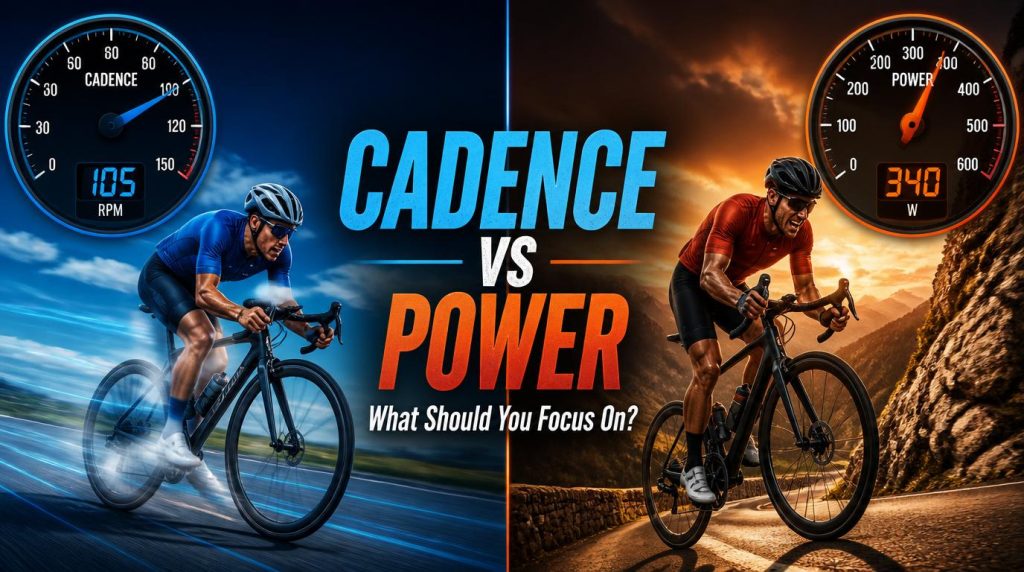
Ask ten cyclists whether cadence or power matters more, and you will likely get ten different answers — along with strong opinions about “spinners” versus “grinders.” The truth is that cadence and power are not competing metrics. They are two halves of the same equation, and understanding how they interact is more useful than picking one to prioritise over the other.
This guide explains what each metric actually measures, how they relate to each other mechanically, and how to think about both in your training.
Table of Contents
- What Is Cadence?
- What Is Power?
- How Cadence and Power Relate to Each Other
- Ideal Cadence Ranges
- Why Some Riders Naturally Prefer Higher or Lower Cadence
- Gear Ratio’s Role in Cadence and Power
- Training Cadence
- Training Power
- Which Should You Prioritise?
- Common Mistakes to Avoid
- FAQ
What Is Cadence?
Cadence is simply how fast you turn the pedals, measured in revolutions per minute (RPM). It is tracked by a cadence sensor (often built into power meters, or available as a standalone magnet-based sensor) and displayed on most cycling computers and smartwatches.
Cadence on its own tells you nothing about how hard you are working — a rider spinning at 90 RPM in an easy gear on flat ground is working far less hard than a rider grinding at 90 RPM up a steep climb in a hard gear. This is exactly why cadence needs to be considered alongside gear ratio and power, not in isolation.
What Is Power?
Power, measured in watts, represents the actual mechanical work you are producing — a direct measurement of how hard you are working, independent of cadence, gear choice, or terrain.
Power is measured using a power meter, typically built into the crankset, pedals, or rear hub, which measures the force you apply combined with the speed of rotation to calculate watts in real time.
Unlike cadence, power is a genuinely objective measure of effort. A rider producing 250 watts is doing the same mechanical work whether they achieve it at 70 RPM in a hard gear or 100 RPM in an easier gear — the watts are identical, even though the experience feels very different.
How Cadence and Power Relate to Each Other
The relationship between cadence, gear ratio, and power can be understood through a simple concept: power is the product of force and speed.
In cycling terms, this means the same power output can be achieved through different combinations of:
- Higher cadence + lower force per pedal stroke (spinning an easier gear faster)
- Lower cadence + higher force per pedal stroke (grinding a harder gear slower)
Neither combination is inherently “more powerful” — 250 watts is 250 watts regardless of how you arrived at it. What differs is which muscle systems and energy pathways are emphasised, and how sustainable that effort feels for different riders.
Why This Matters Practically
This is why two riders climbing the same hill at the same speed can have completely different cadences — one spinning at 95 RPM, the other grinding at 65 RPM — while producing very similar power output. Neither is doing it “wrong”; they are simply distributing the same mechanical work differently across force and speed.
Ideal Cadence Ranges
While individual variation is significant (more on this below), general research-backed ranges provide a useful starting reference.
Road Cycling
| Riding Context | Typical Cadence Range |
|---|---|
| Steady endurance riding | 80–95 RPM |
| Climbing (seated) | 70–90 RPM |
| Sprinting | 100–130 RPM (brief, maximal efforts) |
| Time trial / sustained high effort | 85–100 RPM |
Mountain Biking
| Riding Context | Typical Cadence Range |
|---|---|
| Technical climbing | 60–80 RPM |
| Smooth trail riding | 70–90 RPM |
| Sprinting/short efforts | 90–110 RPM |
MTB cadence tends to run lower than road cycling overall, reflecting the need for more torque and control on technical, variable terrain, where a very high cadence can reduce precision over technical features.
Why 90 RPM Is Often Cited as “Ideal”
Research on elite cyclists has frequently found a preference for cadences in the 90–100 RPM range during steady efforts, often attributed to a more favourable balance between muscular force per pedal stroke and cardiovascular demand at this range. However, this finding reflects population averages and elite-level physiology — it is not a universal prescription that suits every individual rider equally well.
Why Some Riders Naturally Prefer Higher or Lower Cadence
Muscle Fibre Composition
Riders with a higher proportion of fast-twitch muscle fibres often find lower cadence, higher force pedalling more natural and efficient, while riders with more slow-twitch fibres often gravitate toward higher cadence, lower force pedalling.
Training Background
Riders with a background in track cycling or sprint-focused disciplines often develop a preference for and comfort with higher cadences, while riders from a strength-sport background (or simply long-term habit) may naturally prefer lower cadence, higher force pedalling.
Biomechanics and Flexibility
Hip and knee range of motion, leg length, and joint health can all influence which cadence feels most comfortable and efficient for an individual rider, independent of fitness level.
Years of Riding Experience and Habit
Pedalling style is partly learned and reinforced over years of riding. A rider who has spent a decade grinding lower cadences may find a significant cadence increase initially uncomfortable and even less efficient, despite general research suggesting higher cadence benefits — adaptation takes time.
The practical implication: general guidelines are a useful starting point, but your own comfortable and efficient cadence may genuinely differ from population averages, and that is not necessarily a problem to “fix.”
Gear Ratio’s Role in Cadence and Power
Your gear ratio is the direct mechanical link between your cadence and your speed — and indirectly, between your cadence and the force required per pedal stroke at a given power output.
Speed = Cadence × Gear Ratio × Wheel Circumference
This means for any given speed, choosing a higher gear ratio requires a lower cadence (more force per stroke), while choosing a lower gear ratio requires a higher cadence (less force per stroke) to maintain the same speed.
Practical Application
If you find yourself unable to reach your preferred cadence range on climbs — for example, your cadence drops to 50 RPM on steep gradients despite trying to spin faster — this is very likely a gearing limitation, not a fitness issue. A lower gear ratio (smaller chainring or larger cassette cog) would allow you to maintain a higher, more efficient cadence at the same power output and speed.
Use our Gear Ratio Calculator to check whether your current setup allows your preferred cadence range across the terrain you typically ride, particularly your steepest regular climbs.
Training Cadence
High-Cadence Drills
Riding at a deliberately high cadence (100–110+ RPM) for short intervals, often on flat terrain or a trainer, develops neuromuscular coordination and pedalling smoothness, particularly useful for riders who naturally default to lower cadences and want to expand their comfortable range.
Low-Cadence Strength Intervals
Riding at a deliberately low cadence (50–60 RPM) at moderate-to-high power, often on a gradual climb or trainer with resistance, builds muscular strength and force production capacity, useful for riders who want to improve their ability to produce force per pedal stroke, which can benefit climbing and sprinting.
Cadence Variation in Normal Riding
Beyond dedicated drills, simply paying attention to cadence during normal rides — and consciously varying it across different terrain rather than defaulting to one habitual cadence regardless of conditions — helps develop a wider comfortable range over time.
Training Power
Power as a Training Metric
Unlike cadence, which is somewhat preference-dependent, power is the primary objective metric used in structured training, typically organised around FTP (Functional Threshold Power) — the highest power you can sustain for approximately one hour.
Training Zones Based on Power
Most structured training plans define zones as percentages of FTP, from low-intensity endurance riding (around 55–75% of FTP) up to maximal anaerobic efforts (over 150% of FTP for very short durations). This allows precise, individualised training intensity regardless of cadence preference, terrain, or even weather conditions affecting speed.
Why Power Is More Reliable Than Speed for Training
Speed varies with wind, gradient, and drafting, making it an unreliable measure of effort across different conditions. Power output reflects your actual physiological effort directly, making it the preferred metric for structured training where consistent, comparable intensity matters.
Which Should You Prioritise?
If You Are New to Structured Training
Power is generally the more useful metric to prioritise first, since it directly measures effort and allows you to track genuine fitness progression over time, independent of cadence preference.
If You Experience Joint Pain or Discomfort
Cadence deserves more attention. Very low cadence (high force per stroke) can contribute to knee strain for some riders, particularly if saddle height or other bike fit elements are not optimally set. Experimenting with a moderate cadence increase is a reasonable first step if joint discomfort is a recurring issue, alongside checking bike fit fundamentals.
If You Are Preparing for a Specific Event
Consider the demands of that event. A hilly gran fondo with sustained climbing benefits from comfort across a range of cadences and strong sustained power; a criterium with frequent accelerations benefits from both high-cadence sprint capability and strong short-duration power.
The Practical Answer
For most riders, the more useful framing is not “cadence versus power” but “power as the training target, cadence as the tool you adjust (via gearing and pedalling style) to deliver that power comfortably and sustainably.” Both matter, but they are not actually in competition with each other.
Common Mistakes to Avoid
Mistake 1: Forcing a “Correct” Cadence That Feels Unnatural
Population averages and elite athlete data are useful reference points, not a mandate. If a significantly different cadence feels consistently more comfortable and sustainable for you, that is valid information about your individual physiology, not necessarily something to override.
Mistake 2: Ignoring Gearing as a Cadence Solution
If you cannot reach a comfortable cadence on climbs, the answer is often a gearing change (smaller chainring, larger cassette cog) rather than purely a fitness or willpower issue. Check your gear ratio range against your local terrain.
Mistake 3: Using Speed as a Training Intensity Metric
Speed is heavily influenced by wind, gradient, and drafting, making it unreliable for comparing effort across different rides or conditions. Power (or, as a less precise alternative, heart rate) is a more consistent measure of actual physiological effort.
Mistake 4: Neglecting Cadence Variation Training
Defaulting to the same habitual cadence in every situation, regardless of terrain or goal, limits your flexibility and can leave you under-prepared for situations (steep climbs, sprints) that benefit from a different cadence approach.
Mistake 5: Assuming Higher Cadence Is Always More Efficient
While research often favours moderate-to-high cadence for sustained efforts in many riders, this is not universal, and forcing an unnaturally high cadence without adaptation time can reduce efficiency and comfort rather than improving it.
FAQ
Is high cadence or low cadence better for cycling?
Neither is universally better — both can produce the same power output, and the ideal cadence varies by individual physiology, training background, and the specific demands of the riding situation. Research often favours a moderate-to-high cadence (85–100 RPM) for sustained road efforts, but individual variation is significant.
What is a good average cycling cadence?
For steady endurance road riding, 80–95 RPM is a commonly cited comfortable range for most riders. Climbing often involves somewhat lower cadence (70–90 RPM), while sprinting involves much higher cadence (100–130 RPM) for brief efforts.
Does cadence affect power output?
Not directly — the same power output can be achieved at different cadences by adjusting the force applied per pedal stroke. However, cadence does affect which muscle systems and energy pathways are emphasised, and how sustainable a given power output feels to an individual rider.
Why can’t I maintain a high cadence on climbs?
This is very often a gearing limitation rather than a fitness issue. If your current gear ratio does not include a low enough option for the gradient you are climbing, your cadence will naturally drop regardless of effort. Check whether a lower gear ratio (smaller chainring or larger cassette cog) would help, using our Gear Ratio Calculator.
Should I train with a power meter or just focus on cadence?
Power is generally the more useful primary training metric, since it directly measures physiological effort independent of terrain, wind, or pedalling style. Cadence is a useful secondary metric and training tool, but power provides more reliable, comparable data for tracking fitness progression over time.
Can changing my cadence improve my cycling performance?
For some riders, yes — particularly those who have never experimented outside a narrow habitual cadence range. Cadence training drills (both high-cadence and low-cadence intervals) can develop a wider comfortable range, potentially improving efficiency and reducing strain in certain situations like climbing or sprinting.
Summary
Cadence and power are not competing priorities — they are two related variables that, together with gear ratio, determine how you deliver any given effort on the bike.
Key takeaways:
- Power (watts) is the objective measure of effort; cadence (RPM) is the rate at which you deliver it
- The same power output can be achieved at different cadences by adjusting force per stroke
- Individual cadence preference varies significantly — population averages are a reference, not a mandate
- If you cannot maintain a comfortable cadence on climbs, check your gearing before assuming it is a fitness issue
- For structured training, power is generally the more reliable primary metric
Check whether your gearing supports your ideal cadence range. Use our Gear Ratio Calculator →