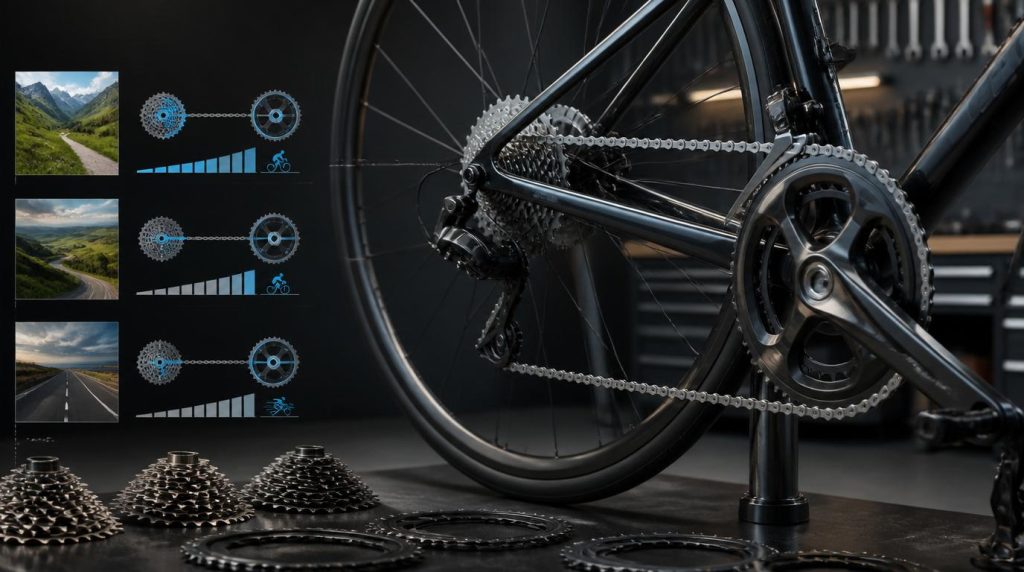
Walk into any bike shop and you will see chainset and cassette options described with numbers like “50/34” or “11-32” — shorthand that means little if you do not already know how to read it. Yet this combination is one of the biggest factors in how a bike feels on climbs, on flats, and everywhere in between.
This guide explains how to read these numbers, how chainring and cassette choices interact, and how to choose the right combination for your terrain, fitness level, and riding goals.
Table of Contents
- Reading Chainring and Cassette Numbers
- Chainset Types: Standard, Compact, and Sub-Compact
- Cassette Range: What the Numbers Mean
- 1x vs 2x Drivetrains
- Matching Your Combo to Your Terrain
- Matching Your Combo to Your Fitness Level
- How to Use a Gear Ratio Calculator to Compare Combos
- Compatibility: What You Can and Cannot Mix
- Common Mistakes to Avoid
- FAQ
Reading Chainring and Cassette Numbers
Chainset Numbers
A chainset (or crankset) is described by the tooth count of its chainring(s), written as a single number for 1x setups or two numbers for 2x setups.
Example: 50/34 means a 50-tooth large chainring and a 34-tooth small chainring. The larger number is always listed first.
Cassette Numbers
A cassette is described by its smallest and largest cog tooth counts.
Example: 11-32 means the smallest cog has 11 teeth and the largest has 32 teeth. The cassette also has a number of cogs in between, evenly or progressively spaced, but the two end numbers are what is typically referenced when comparing range.
Putting Them Together
When you see a bike described as “50/34 with 11-32,” this tells you:
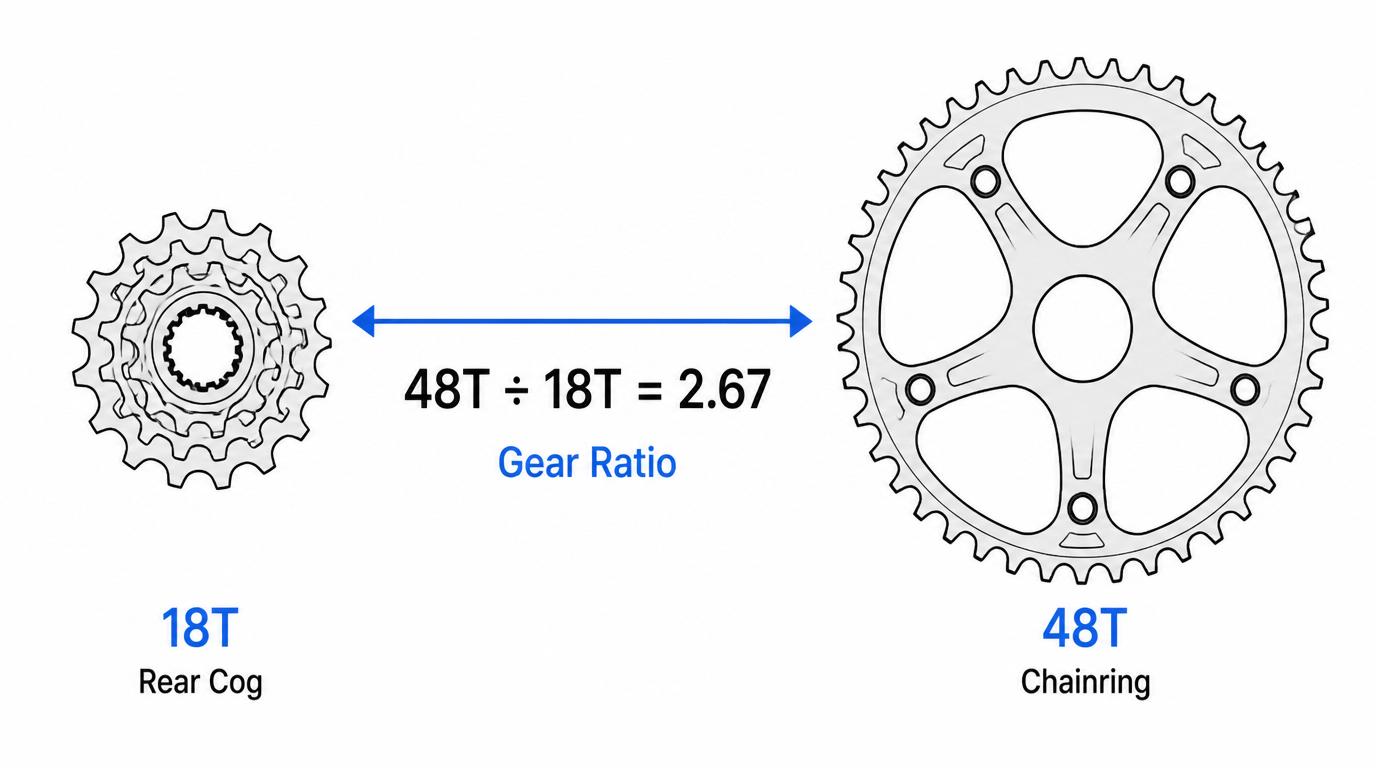
- Largest gear ratio (hardest): 50 ÷ 11 = 4.55
- Smallest gear ratio (easiest): 34 ÷ 32 = 1.06
This combination gives you a wide range from very hard (fast descending/sprinting) to quite easy (steep climbing).
Chainset Types: Standard, Compact, and Sub-Compact
Road chainsets fall into three broad categories, each suited to different riding demands.
Standard Chainset (53/39)
The traditional racing chainset, offering the highest top-end gear ratios for fast, flat, or rolling terrain. Best suited to strong riders, racers, and those riding predominantly flat terrain where maximum speed potential matters more than easy climbing gears.
Compact Chainset (50/34)
The most popular choice for recreational and many competitive cyclists today. Offers a meaningfully easier climbing gear than standard, while sacrificing only a small amount of top-end speed potential — and even that gap can be closed somewhat by an appropriate cassette choice. Compact has become something of a default recommendation for most road cyclists, regardless of fitness level, simply because it offers more usable range without significant downside.
Sub-Compact Chainset (48/32 or 46/30)
Designed for riders who frequently tackle steep or sustained climbs and want notably easier gearing than even a compact chainset provides. Increasingly common on gravel bikes and among road cyclists in mountainous regions.
Comparison Table
| Chainset Type | Typical Sizes | Best For |
|---|---|---|
| Standard | 53/39 | Flat terrain, racing, strong riders |
| Compact | 50/34 | Most recreational and competitive riding |
| Sub-Compact | 48/32, 46/30 | Mountainous terrain, climbing-focused riders |
Cassette Range: What the Numbers Mean
The cassette’s largest cog determines your easiest available gear when paired with your smallest chainring. The smallest cog determines your hardest available gear when paired with your largest chainring.
Common Road Cassette Ranges
| Cassette | Range Character | Best For |
|---|---|---|
| 11-25 | Tight range, close gaps | Flat racing, criteriums |
| 11-28 | Moderate range | General road riding, rolling terrain |
| 11-30 / 11-32 | Wide range | Hilly terrain, mixed riding |
| 11-34 | Very wide range | Mountainous terrain, touring |
The Trade-Off: Range vs Gaps
A cassette with a narrower range (like 11-25) has smaller jumps between each cog, allowing finer cadence control — useful when racing and needing precise gear selection at speed. A wider-range cassette (like 11-32) has bigger jumps between cogs, trading fine control for a wider overall span of available gears.
Neither is “better” universally — the right choice depends on whether you prioritise fine control or wide range for your typical riding.
1x vs 2x Drivetrains
A significant decision, particularly relevant for gravel and mountain bikes, is whether to run a single chainring (1x) or a traditional double chainring (2x) setup.
1x (Single Chainring) Advantages
- Simpler mechanically — no front derailleur to maintain or adjust
- No chain drops from front shifting — eliminates a common mechanical issue, particularly valuable off-road
- Lighter weight — removing the front derailleur and one chainring saves weight
- Wider range cassettes available — modern 1x-specific cassettes (10-50, 10-52) provide huge range to compensate for having only one chainring
1x Disadvantages
- Bigger jumps between gears — with only one chainring’s worth of cogs to cover the full range, gaps between gears are necessarily larger
- Less fine cadence control — particularly noticeable to road cyclists used to 2x systems with smaller jumps
2x (Double Chainring) Advantages
- Finer gear steps — more total gear combinations available, with smaller jumps between them
- Better for racing — fine cadence control matters more in competitive road racing
- Often slightly better chainline — depending on specific setup, can reduce cross-chaining in commonly used gears
2x Disadvantages
- More complex — front derailleur adds a maintenance and adjustment point
- Risk of front shifting issues — dropped chains, rub, and adjustment drift are more common failure points
- Heavier — extra chainring and front derailleur add weight
Which Should You Choose?
| Riding Style | Recommendation |
|---|---|
| Road racing, group rides | 2x — finer control matters |
| Gravel, adventure riding | 1x — simplicity and reliability favoured |
| Mountain biking (modern) | 1x — near-universal standard today |
| Touring, bikepacking | Either — 2x for fine control with heavy loads, 1x for simplicity |
| Commuting | 1x — simplicity and lower maintenance preferred |
Matching Your Combo to Your Terrain
Flat to Rolling Terrain
A standard or compact chainset (53/39 or 50/34) with a moderate cassette (11-25 or 11-28) provides plenty of range without unnecessary easy gears you will rarely use.
Hilly Terrain
A compact chainset (50/34) paired with a wider cassette (11-30 or 11-32) provides a noticeably easier climbing gear while retaining good top-end speed for descents and flats.
Mountainous Terrain
A sub-compact chainset (48/32 or 46/30) paired with a wide cassette (11-32 or 11-34) gives you genuinely easy climbing gears for sustained steep gradients, at some cost to maximum speed on descents — a sensible trade-off for terrain where climbing dominates the ride.
Gravel and Mixed Terrain
A 1x setup with a wide-range cassette (10-42 to 10-50) is increasingly the default choice, providing enough range to handle both fast gravel roads and steep, loose climbs without the complexity of front shifting in dusty or muddy conditions.
Mountain Biking
Modern MTB drivetrains are almost universally 1×12 (or 1×11), with a single chainring (typically 28–34 teeth) paired with an extremely wide-range cassette (10-50 or 10-52), providing both low climbing gears for technical ascents and reasonable top-end speed for descents and flat sections.
Matching Your Combo to Your Fitness Level
Gearing should serve your actual fitness and riding goals, not an idea of what “serious cyclists” should ride.
New or Returning Cyclists
A compact or sub-compact chainset paired with a wide-range cassette provides accessible gearing while you build fitness, without forcing you into gears that are uncomfortably hard on climbs.
Recreational Riders
Compact chainset (50/34) with a moderate-to-wide cassette (11-28 to 11-32) covers the vast majority of recreational riding comfortably.
Competitive Riders
Standard or compact chainset depending on local terrain, paired with a cassette chosen for the specific demands of races or events — tighter range for flat criteriums, wider range for hilly road races or gran fondos.
There Is No Shame in “Easier” Gearing
A common misconception is that easier gearing (smaller chainrings, wider cassettes) is only for beginners or weaker riders. In reality, many strong climbers and professional cyclists choose compact or sub-compact setups specifically because spinning a slightly easier gear at a higher cadence is often more efficient than grinding a harder gear at a lower cadence, particularly on sustained climbs.
How to Use a Gear Ratio Calculator to Compare Combos
Comparing chainring and cassette combinations by mental math is slow and error-prone. Our Gear Ratio Calculator lets you input any combination and instantly see:
- The full range of gear ratios across every chainring/cog combination
- Gear inches and development for comparing against a different bike’s setup
- Speed at a given cadence for each gear, helping you visualise real-world performance
How to use it to make a decision:
- Enter your current (or a candidate) chainring and cassette combination
- Compare the resulting gear range against the terrain you ride most — does the lowest gear feel adequate for your steepest regular climb?
- Compare a few candidate combinations side by side before purchasing new components, rather than guessing based on the labels alone
Compatibility: What You Can and Cannot Mix
Front Derailleur Capacity
Front derailleurs are rated for a maximum difference between large and small chainring teeth (typically 16 teeth for standard, slightly less for compact-specific derailleurs). Exceeding this capacity can cause poor or unreliable shifting.
Rear Derailleur Capacity
Rear derailleurs have a maximum total capacity, calculated as: (largest chainring − smallest chainring) + (largest cog − smallest cog). Exceeding this capacity, commonly when fitting a much wider-range cassette than the derailleur was designed for, can cause the chain to be too long or too short for some gear combinations, or the derailleur to be unable to take up enough chain slack.
Cross-Brand and Cross-Generation Compatibility
Shimano, SRAM, and Campagnolo components are not always interchangeable, particularly at higher speed counts (11 and 12-speed), due to differences in cable pull ratios and chain width. Mixing brands or generations should be researched carefully or discussed with a knowledgeable mechanic before purchase, as an incompatible mix can result in unreliable shifting regardless of how the parts are adjusted.
Wide-Range Cassettes and Specific Derailleurs
Modern wide-range cassettes (10-50, 10-52) typically require derailleurs specifically designed for that range. Fitting one to a standard derailleur not rated for that capacity is unlikely to work correctly, even with adjustment.
Common Chainring and Cassette Mistakes to Avoid
Mistake 1: Choosing Based on What “Serious” Cyclists Ride
Gearing should match your terrain and fitness, not a perception of what is impressive. A compact or sub-compact setup is not a lesser choice — it is often the more efficient one for many riders and terrains.
Mistake 2: Upgrading the Cassette Without Checking Derailleur Compatibility
Fitting a wider-range cassette than your derailleur is rated for, without also upgrading the derailleur, often results in poor shifting performance regardless of careful adjustment.
Mistake 3: Ignoring Front Derailleur Capacity When Choosing a Chainset
Switching from a standard to a sub-compact chainset, or vice versa, can exceed your front derailleur’s rated tooth-difference capacity if not checked, leading to unreliable front shifting.
Mistake 4: Assuming More Gears Means Better Range
The number of gears (speed count) tells you how many steps you have within your range — it does not tell you what that range actually is. A 10-speed cassette with a wide range (11-42) can offer more usable range than an 11-speed cassette with a narrow range (11-25).
Mistake 5: Not Considering Future Terrain or Goals
If you are planning to ride more challenging terrain in the future — entering a hilly event, planning a touring trip — consider whether your current setup will still serve you, or whether it is worth choosing slightly wider-range gearing now to avoid a component change later.
FAQ
What is the difference between standard and compact chainsets?
A standard chainset (53/39) offers higher top-end gear ratios suited to flat terrain and strong riders, while a compact chainset (50/34) offers an easier climbing gear at a small cost to top-end speed. Compact has become the more popular choice for most recreational and many competitive cyclists.
Should I choose 1x or 2x for my gravel bike?
1x setups offer mechanical simplicity and reliability, particularly valuable in muddy or dusty conditions, while 2x setups offer finer gear steps and more total range options. Many gravel riders choose 1x for its simplicity, but 2x remains a valid choice for those who prioritise fine cadence control.
What cassette range do I need for hilly terrain?
For hilly terrain, an 11-30 or 11-32 cassette paired with a compact chainset (50/34) generally provides enough range for comfortable climbing without sacrificing too much top-end speed. For genuinely mountainous terrain, consider an 11-34 cassette or a sub-compact chainset.
Can I put any cassette on my bike?
Not necessarily. Your rear derailleur has a maximum capacity for the largest cog size and total range it can handle. Fitting a cassette outside this rated capacity, without also upgrading the derailleur, often results in poor shifting performance.
Is a compact chainset only for beginners or weaker riders?
No, this is a common misconception. Many strong and even professional cyclists use compact or sub-compact chainsets because an easier gear at a higher cadence is often more efficient than a harder gear at a lower cadence, particularly on sustained climbs.
How do I know if my front derailleur is compatible with a new chainset?
Check your front derailleur’s rated maximum capacity for the difference between large and small chainring teeth (commonly printed in the product specifications). If the new chainset’s tooth difference exceeds this rating, shifting performance is likely to suffer.
Which calculator should I use to compare chainring and cassette combinations?
Our Gear Ratio Calculator lets you enter any chainring and cassette combination and instantly see the resulting gear ratios, gear inches, and speed at different cadences — making it easy to compare options before buying new components.
Summary
Choosing the right chainring and cassette combination comes down to matching your gearing to your terrain, fitness level, and riding goals — not following a generic recommendation or chasing what looks impressive.
Key takeaways:
- Compact (50/34) suits most recreational and competitive riders
- Sub-compact (48/32, 46/30) suits mountainous terrain and climbing-focused riding
- Wider cassettes trade fine control for greater range — choose based on your terrain
- 1x offers simplicity; 2x offers finer steps — both are valid depending on priorities
- Always check derailleur capacity before upgrading cassettes or chainsets
Ready to compare gear combinations for your bike? Use our Gear Ratio Calculator →