Buying a bike in the wrong frame size is one of the most common and costly mistakes a cyclist can make. Too small and you feel cramped, your handling suffers, and your back aches. Too large and you cannot control the bike properly and risk serious discomfort on longer rides.
The right frame size is the foundation of every good bike fit. Everything else — saddle height, handlebar reach, stem length — is adjusted around it. Get the frame size right and the rest of the fit falls into place naturally.
This guide covers everything you need to know to find your correct frame size, whether you are buying a road bike, mountain bike, or hybrid.
Table of Contents
- Why Frame Size Matters
- How Bikes Are Measured
- How to Take Your Body Measurements
- Road Bike Frame Size Chart
- Mountain Bike Frame Size Chart
- Hybrid and City Bike Frame Size Chart
- How to Use a Frame Size Calculator
- What to Do When You Are Between Sizes
- How to Test a Frame Size Before Buying
- Common Mistakes to Avoid
- FAQ
Why Frame Size Matters
A bike frame is not adjustable in the way that a saddle or handlebar is. You can move your saddle up or down, forward or back. You can swap stems and handlebars. But the frame itself — the triangle of tubes that defines the geometry of the bike — is fixed.
This means that if the frame is the wrong size for your body, no amount of component adjustment will make it fit correctly. You will always be compensating, and that compensation shows up as discomfort, reduced efficiency, or injury over time.
The right frame size means:
- Correct reach — you are not stretched out too far or cramped up too close to the handlebars
- Correct stack — the handlebar height relative to the saddle suits your flexibility and riding style
- Correct standover — you can safely straddle the top tube when stopped
- Correct handling — the bike responds predictably because your weight is distributed correctly
A professional bike fit always starts with confirming that the frame size is appropriate before any other adjustments are made.
How Bikes Are Measured
Understanding how frame sizes are described will help you compare bikes across different brands.
Frame Size in Centimetres (Road Bikes)
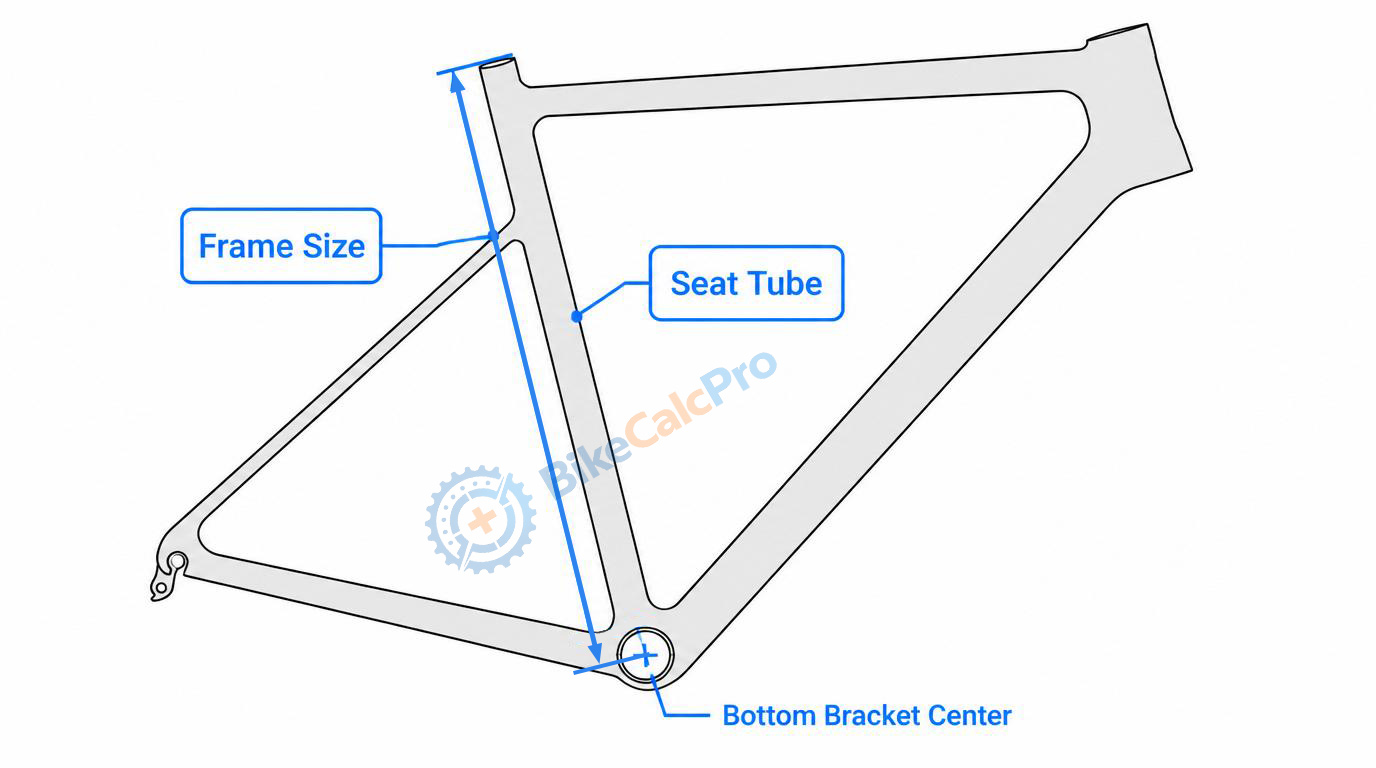
Road bike frames are traditionally measured in centimetres along the seat tube — from the centre of the bottom bracket to the top of the seat tube. A 54 cm road bike has a 54 cm seat tube.
Some manufacturers measure to the top of the seat tube (centre-to-top, or C-T), while others measure to the centre of the top tube junction (centre-to-centre, or C-C). This can create a difference of 1–2 cm between brands for what is nominally the same size.
Frame Size in Inches (MTB and Older Road Bikes)
Mountain bikes and some older road bikes use inches for the seat tube measurement. A 17-inch MTB frame has a 17-inch seat tube.
S / M / L / XL Sizing
Many modern bikes — especially MTBs and hybrids — use t-shirt sizing (XS, S, M, L, XL, XXL). Each brand defines these sizes slightly differently, so always check the manufacturer’s geometry chart rather than relying on the size label alone.
What the Size Charts Below Show
The charts in this guide show the recommended frame size based on your height and inseam. These are starting points — individual proportions vary, and the charts should be used alongside the calculator and, ideally, a test ride.
How to Take Your Body Measurements
You need two measurements to find your frame size: height and inseam.
Height
Measure in the morning if possible — you are slightly taller in the morning than in the evening due to spinal compression throughout the day. Stand against a wall without shoes, heels together, and measure to the top of your head.
Inseam (Cycling Inseam)
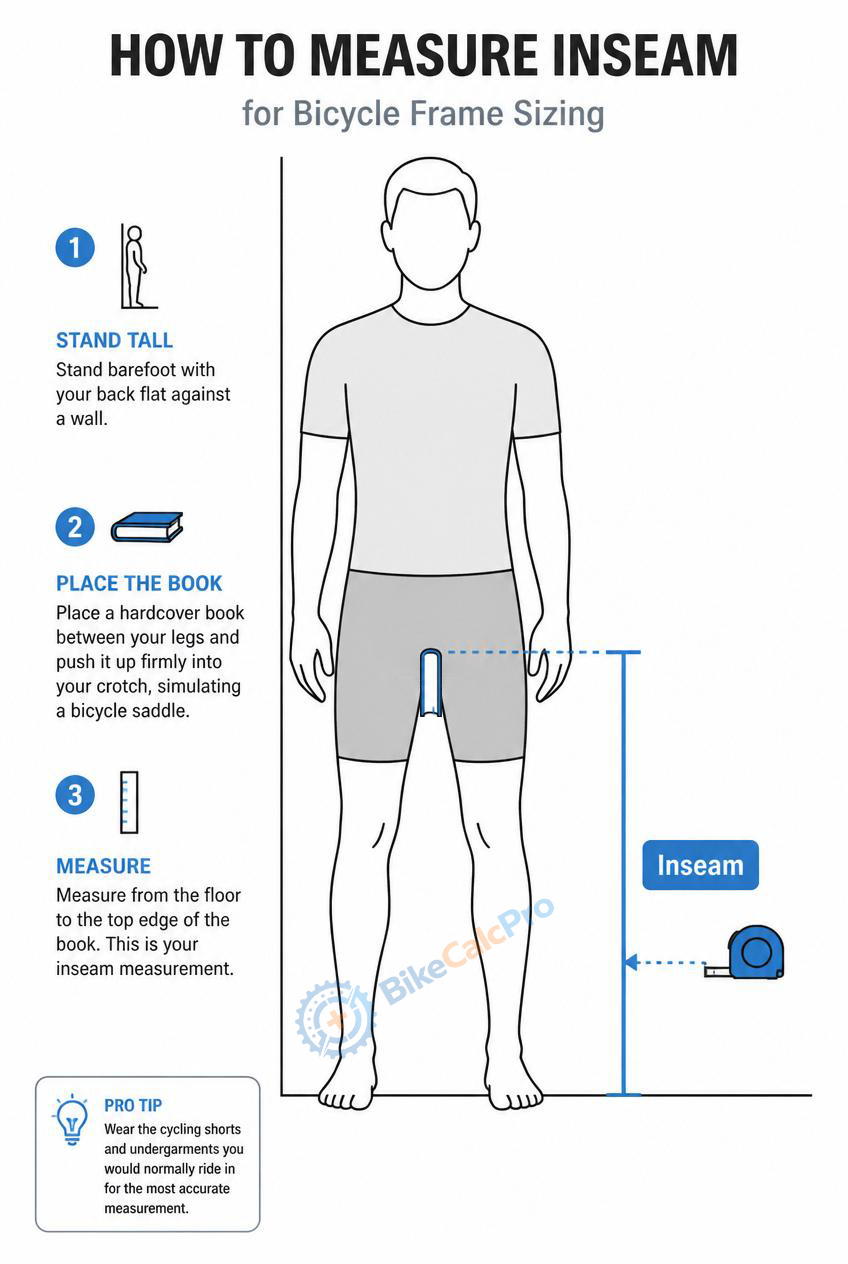
This is the same measurement used for saddle height — your barefoot cycling inseam, not your trouser size.
- Stand barefoot with feet 15–20 cm apart
- Place a hardback book between your legs, spine upward, pressed firmly against your pubic bone
- Mark the wall at the top of the book
- Measure from the floor to the mark in centimetres
Write down both measurements. These are your inputs for every frame size chart and calculator.
Road Bike Frame Size Chart
| Rider Height | Inseam | Frame Size (cm) | Frame Size (generic) |
|---|---|---|---|
| 155–160 cm | 72–75 cm | 47–49 cm | XXS |
| 160–165 cm | 74–77 cm | 49–51 cm | XS |
| 165–170 cm | 76–79 cm | 51–53 cm | S |
| 170–175 cm | 78–82 cm | 53–55 cm | S–M |
| 175–180 cm | 81–84 cm | 55–57 cm | M |
| 180–185 cm | 83–86 cm | 57–59 cm | M–L |
| 185–190 cm | 85–88 cm | 59–61 cm | L |
| 190–195 cm | 87–90 cm | 61–63 cm | XL |
| 195 cm+ | 90 cm+ | 63–65 cm | XXL |
Note: These are general guidelines. Always check the specific geometry chart for the bike you are considering, as sizing varies between manufacturers and even between models from the same brand.
Mountain Bike Frame Size Chart
| Rider Height | Inseam | Frame Size (inches) | Frame Size (generic) |
|---|---|---|---|
| 155–160 cm | 69–73 cm | 13–14″ | XS |
| 160–168 cm | 72–76 cm | 15–16″ | S |
| 168–176 cm | 75–79 cm | 17–18″ | M |
| 176–183 cm | 78–82 cm | 19–20″ | L |
| 183–191 cm | 81–85 cm | 21–22″ | XL |
| 191 cm+ | 84 cm+ | 23–24″ | XXL |
MTB note: Modern trail and enduro geometry has shifted toward longer, lower, and slacker frames. Many riders now size down one size from the traditional chart and use a longer stem or a bike with longer reach numbers. Always check the reach measurement in the geometry table, not just the frame size label.
Hybrid and City Bike Frame Size Chart
| Rider Height | Frame Size (cm) | Frame Size (inches) | Frame Size (generic) |
|---|---|---|---|
| 148–155 cm | 40–44 cm | 15–16″ | XS |
| 155–165 cm | 44–48 cm | 16–17″ | S |
| 165–175 cm | 48–52 cm | 17–19″ | M |
| 175–183 cm | 52–56 cm | 19–21″ | L |
| 183–191 cm | 56–58 cm | 21–22″ | XL |
| 191 cm+ | 58–62 cm | 22–24″ | XXL |
Hybrid note: Hybrid and city bikes prioritise an upright, comfortable riding position. The frame size affects reach to the handlebars significantly — if you are between sizes, sizing up usually gives a more comfortable, less aggressive position.
How to Use a Frame Size Calculator
Size charts give you a range — a calculator gives you a personalised recommendation based on your specific measurements.
Our Frame Size Calculator takes your height and inseam and returns:
- Recommended frame size in centimetres (for road bikes)
- Recommended frame size in inches (for MTB)
- Generic size label (S, M, L, etc.)
- Notes on whether you are close to a size boundary
How to get the most accurate result:
- Use your barefoot height measured against a wall
- Use your barefoot cycling inseam (measured as described above — not your trouser inseam)
- Select your bike type — road, MTB, or hybrid — as sizing logic differs between disciplines
The calculator result is your starting point. If you are between sizes, read the next section carefully.
What to Do When You Are Between Sizes
Being between frame sizes is common. Most manufacturers have overlapping size ranges for exactly this reason. Here is how to decide:
Size Down If:
- You prefer a more aggressive, aerodynamic riding position
- You have shorter arms relative to your height (shorter reach preferred)
- You are buying an MTB for technical trail riding (more manoeuvrable on a smaller frame)
- You want more standover clearance
Size Up If:
- You prefer a more relaxed, upright riding position
- You have longer arms relative to your height (more reach preferred)
- You are buying a road bike for long-distance or endurance riding
- Comfort is your priority over performance
Check the Geometry Table
When you are between sizes, do not just look at the seat tube length. Look at the full geometry table for the bike:
- Reach — horizontal distance from bottom bracket to head tube top. This is the most important number for how the bike feels.
- Stack — vertical height from bottom bracket to head tube top. Higher stack = more upright position.
- Top tube length (effective) — horizontal length of the top tube. Affects how stretched out you feel.
Compare these numbers between the two sizes. The size whose reach and stack numbers better match your body proportions is the right choice.
How to Test a Frame Size Before Buying
If at all possible, test ride before you buy. Here is what to check during a test:
Standover Clearance
Straddle the bike with both feet flat on the ground. You should have at least:
- 2–5 cm clearance for a road bike (between top tube and your body)
- 5–10 cm clearance for an MTB
- 5–8 cm clearance for a hybrid
If the top tube contacts you before you have clearance, the frame is too large.
Reach to the Handlebars
Sit in your normal riding position. Your arms should have a slight bend at the elbow — not fully locked out, not severely bent. A slight, comfortable bend means the reach is appropriate.
Knee Over Pedal Axle (KOPS)
With the cranks horizontal and your forward foot over the front pedal axle, your kneecap should be directly above the pedal axle. This is a rough check — it can be refined with saddle fore-aft adjustment — but it gives you an indication of whether the frame length is in the right zone.
Back Angle
In your riding position, your back should be at a comfortable angle — typically 45 degrees for a relaxed road position, flatter for aggressive/race positions. If you are severely hunched or very upright against your preference, the frame geometry may not suit your riding style.
Common Mistakes to Avoid
Mistake 1: Trusting Only the Size Label
A size Medium from one brand is not the same as a size Medium from another. Always check the geometry numbers, not just the label.
Mistake 2: Using Your Trouser Inseam
Your trouser inseam is measured differently from your cycling inseam and is typically 3–5 cm shorter. Using trouser inseam in a frame size calculator will give you an inaccurate result.
Mistake 3: Prioritising Standover at the Expense of Reach
Many riders choose a frame size based on standover clearance alone. But standover is a safety check, not a fitting tool. A frame can pass the standover test and still be the wrong size if the reach is wrong.
Mistake 4: Buying Online Without Checking Geometry
Online bike purchases are convenient but carry risk if you skip the geometry check. Always download the geometry PDF for the specific model and year, and compare the reach and stack numbers to a bike that fits you well.
Mistake 5: Assuming You Cannot Change After Purchase
While the frame size is fixed, many fit adjustments are still possible: saddle height and fore-aft position, stem length (shorter or longer), handlebar width, and spacer height under the stem. A professional bike fitter can often make a slightly wrong frame size work well — but it is always better to start with the right size.
FAQ
How do I know what size bike frame I need?
Measure your height and barefoot inseam, then use a frame size chart or our Frame Size Calculator to find your recommended size. Always cross-check with the geometry table for the specific bike you are considering.
Is bike frame size based on height or inseam?
Both matter. Height gives a general starting point, but inseam is the more precise measurement because it reflects your leg length relative to your torso — which directly affects how you sit on the bike. Our calculator uses both for the most accurate result.
What happens if I ride a bike that is too small?
A frame that is too small forces you into a cramped position. Your knees may hit the handlebars at the top of the pedal stroke, your back will be rounded excessively, and you will lack leverage for efficient pedalling. On the road, a too-small bike also feels twitchy and unstable at speed.
What happens if I ride a bike that is too large?
A frame that is too large puts you in an overstretched position, straining your lower back, shoulders, and neck. You will have difficulty controlling the bike at slow speeds, and you may not be able to reach the ground safely when stopping.
Can I adjust a bike to fit if the frame is slightly the wrong size?
Small discrepancies can often be managed with component changes — a shorter or longer stem, different handlebars, or saddle position adjustments. However, if the frame is more than one size wrong, these adjustments are unlikely to produce a comfortable or efficient fit.
Should I size up or down for a mountain bike?
Modern MTB geometry trends toward sizing down slightly for more playful, manoeuvrable handling on technical terrain. However, if you primarily ride cross-country or long distances, the traditional size or even sizing up may give a more comfortable, efficient position. Check the reach measurement rather than relying on the size label.
Summary
Getting your frame size right is the most important decision when buying a bike. The key steps:
- Measure your height and barefoot cycling inseam accurately
- Use the size charts as a starting point
- Check the geometry table — especially reach and stack
- If between sizes, consider your riding style and body proportions
- Test ride if at all possible before buying
Ready to find your recommended frame size? Use our Bike Frame Size Calculator →