Of all the variables that determine your ideal tire pressure, rider weight has the single biggest impact — more than tire width, more than surface type, more than tube type. Yet it is the factor most generic tire pressure charts get wrong, because they are built around an “average” rider who may be 20 kg heavier or lighter than you.
This guide explains exactly why weight matters so much, how to adjust for your specific weight, and how to get a precise number rather than a generic guess.
Table of Contents
- Why Rider Weight Matters More Than Anything Else
- The Physics: Contact Patch and Load
- What Counts as “Rider Weight” for Tire Pressure
- Tire Pressure Chart by Weight
- Adjusting for Heavier Riders
- Adjusting for Lighter Riders
- Weight Distribution: Front vs Rear
- How to Use a Tire Pressure Calculator for Your Exact Weight
- Common Mistakes to Avoid
- FAQ
Why Rider Weight Matters More Than Anything Else
Every tire pressure recommendation exists to solve the same basic problem: supporting the rider’s weight without the tire deforming too much (too low pressure) or too little (too high pressure) for the surface being ridden.
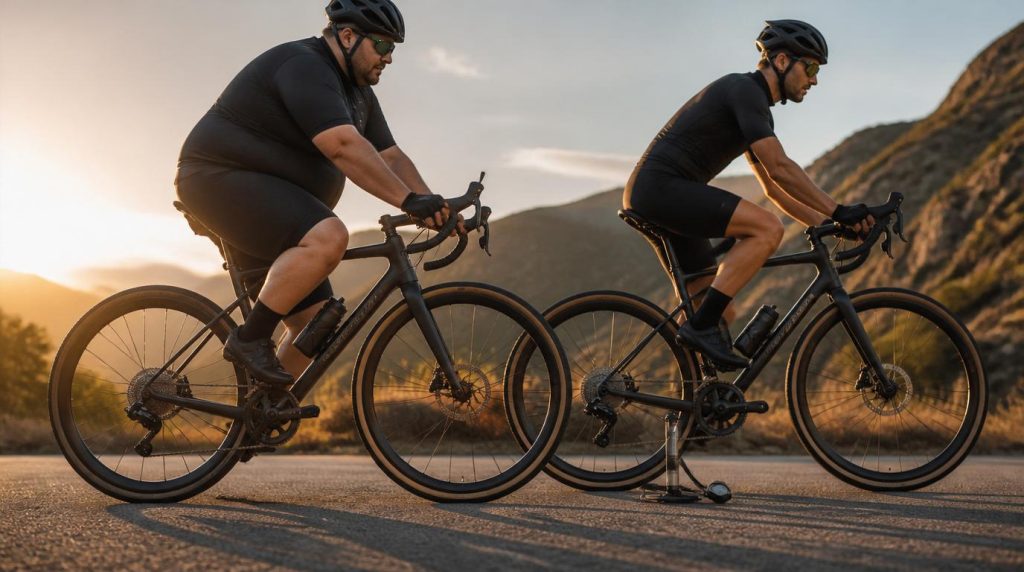
Tire width, surface type, and tube type all matter — but they are essentially modifiers around the central variable of how much load the tire needs to support. A 60 kg rider and a 95 kg rider on the exact same bike, same tires, same surface, will need meaningfully different pressures. Generic charts that give a single number “for road bikes” or “for gravel bikes” are really only accurate for riders close to the average weight the chart assumes — typically 70–75 kg.
This is why two riders following the same generic advice can have completely different experiences: one feels great, the other feels either harsh and bouncy or sluggish and prone to pinch flats.
The Physics: Contact Patch and Load
To understand why weight matters so much, it helps to understand what tire pressure is actually doing.
Your tire supports your weight (combined with the bike and any gear) by creating a contact patch — the area of the tire actually touching the ground. For a given pressure, a heavier load creates a larger contact patch, because the tire needs to deform more to support the extra weight.
If pressure stays the same but weight increases, the contact patch grows beyond the ideal size, increasing rolling resistance and the risk of the tire bottoming out against the rim on impacts (a pinch flat). To restore the ideal contact patch size for a heavier rider, pressure needs to increase.
The reverse is true for lighter riders: keeping pressure at a level designed for a heavier rider results in an under-sized contact patch, reducing grip and making the ride feel harsh, since the tire is no longer deforming enough to absorb terrain irregularities.
This is a simple, predictable relationship — which is exactly why it can be calculated precisely rather than estimated.
What Counts as “Rider Weight” for Tire Pressure
When adjusting tire pressure for weight, use your total system weight — not just your body weight alone.
Include:
- Your body weight
- Cycling clothing and shoes (minor, but every bit counts for precision)
- The bike itself (varies from around 7 kg for a high-end road bike to 14+ kg for an e-bike or heavily loaded touring bike)
- Any gear: water bottles, repair kit, saddle bag, frame bag
- For bikepacking or touring: the full loaded weight of panniers or bags, which can add 5–15+ kg
Why This Matters
A 70 kg rider on an 8 kg road bike with a water bottle has a total system weight of roughly 79 kg. The same rider on a loaded touring setup with 10 kg of gear has a total system weight of roughly 89 kg — a 10 kg difference that genuinely affects the ideal pressure, even though the rider’s own body weight has not changed.
This is also why bikepacking and touring guides often recommend running noticeably higher pressure than a credit-card-light road ride — the loaded weight, not just rider weight, is driving the calculation.
Tire Pressure Chart by Weight
The following chart shows how recommended road bike tire pressure scales with total system weight, for a fixed tire width. Notice how significant the difference is across the weight range — this is the core reason generic, single-number advice fails so many riders.
Road Bike (25mm tire, clincher)
| Total System Weight | Recommended PSI |
|---|---|
| 55–65 kg | 75–85 psi |
| 65–75 kg | 85–95 psi |
| 75–85 kg | 95–105 psi |
| 85–95 kg | 105–115 psi |
| 95–105 kg | 115–125 psi |
| 105 kg+ | 125+ psi (check tire max rating) |
Gravel Bike (40mm tire, tubeless)
| Total System Weight | Recommended PSI |
|---|---|
| 55–65 kg | 25–30 psi |
| 65–75 kg | 30–35 psi |
| 75–85 kg | 35–40 psi |
| 85–95 kg | 40–45 psi |
| 95 kg+ | 45–50 psi |
Mountain Bike (2.4″ tire, tubeless)
| Total System Weight | Recommended PSI |
|---|---|
| 55–65 kg | 20–24 psi |
| 65–75 kg | 24–28 psi |
| 75–85 kg | 28–32 psi |
| 85–95 kg | 32–35 psi |
| 95 kg+ | 35+ psi |
Note: These charts assume a fixed tire width for each discipline. If your tire width differs, use the calculator below for a result that accounts for both variables together.
Adjusting for Heavier Riders
Heavier riders (above approximately 90 kg total system weight) face a specific challenge: standard tire pressure charts often top out before reaching what is actually needed, and many tires have a printed maximum pressure that limits how far you can go.
Practical Adjustments for Heavier Riders
- Check the tire’s maximum rated pressure — printed on the sidewall. Never exceed this, regardless of what a weight-based calculation suggests.
- Consider a wider tire — increasing tire width allows the same pressure to support more weight comfortably, often a better solution than simply maxing out pressure on a narrow tire.
- Prioritise tubeless if not already using it — tubeless setups handle higher pressures more predictably and reduce pinch-flat risk, which becomes more relevant at higher loads.
- Check wheel and rim weight ratings — some lightweight wheelsets have rider weight limits that are worth confirming, particularly for carbon wheels.
- Expect to run nearer the top of the recommended range rather than the middle, and monitor for any unusual wear patterns that might indicate the setup needs further adjustment.
Adjusting for Lighter Riders
Lighter riders (below approximately 60 kg total system weight) face the opposite challenge: standard charts can recommend pressure that is genuinely too high, leading to a harsh ride and reduced grip, particularly noticeable on rough roads or technical terrain.
Practical Adjustments for Lighter Riders
- Do not default to “average” chart numbers — many lighter riders, particularly smaller-framed cyclists and younger riders, end up running 10–20 psi more than they actually need simply because they followed generic advice.
- Test lower pressure than you might expect — lighter riders often find noticeably improved comfort and grip at the lower end of (or even slightly below) standard charts.
- Consider tubeless even at lower pressures — the benefits of reduced pinch-flat risk and improved grip apply just as much to lighter riders running lower pressure as to heavier riders running higher pressure.
- Pay attention to bike and gear weight proportionally — for a 50 kg rider, an 8 kg bike represents a much larger proportion of total system weight than for a 90 kg rider, making bike and gear choice comparatively more influential on the ideal pressure.
Weight Distribution: Front vs Rear
Total weight matters, but how that weight is distributed between your front and rear wheel also affects optimal pressure for each tire individually.
On most bikes, the rear wheel carries approximately 60% of total system weight, with the front carrying the remaining 40%, due to the rider’s centre of gravity sitting closer to the rear of the bike in a typical riding position. This split shifts further toward the rear under acceleration and on climbs, and shifts toward the front during braking and on descents.
This is why the standard recommendation across all disciplines is to run the rear tire 5–10% higher pressure than the front — the rear is supporting more load, and matching pressure exactly between front and rear effectively over-inflates the rear relative to its job and under-inflates the front, or vice versa depending on which number you started from.
For loaded touring or bikepacking, where panniers and bags add weight at specific points (rear rack, front fork, frame bag), this distribution can shift further and may need individual adjustment beyond the standard front/rear split.
How to Use a Tire Pressure Calculator for Your Exact Weight
Charts are useful for understanding the relationship between weight and pressure, but they group riders into weight bands. A calculator gives you a precise number rather than a range.
Our Tire Pressure Calculator uses your exact total system weight alongside tire width, tube type, and surface to calculate a specific recommended pressure — not just a band.
How to get the most accurate result:
- Weigh yourself in your typical riding kit (shoes, clothing) rather than estimating
- Add your bike’s actual weight if you know it — check the manufacturer’s spec sheet if unsure
- Include any gear you regularly carry — water bottles, tools, bags
- For loaded touring or bikepacking, weigh your fully packed bike separately and use that total, as the difference from your “normal” riding weight can be substantial
Common Mistakes to Avoid
Mistake 1: Using Your Body Weight Alone
Forgetting to include bike weight and gear, especially for bikepacking or touring setups, leads to under-inflation and increased pinch-flat risk on loaded rides.
Mistake 2: Following a Friend’s Pressure Setting
A friend’s tire pressure is calibrated to their weight, not yours. Even with identical bikes and tires, a 15–20 kg weight difference between two riders can mean a 15–20 psi difference in ideal pressure.
Mistake 3: Not Re-Checking Pressure After Significant Weight Changes
If your riding weight changes significantly — through training, season changes (winter kit vs summer kit), or switching between unloaded and loaded touring — your ideal pressure changes too, even on the same bike and tires.
Mistake 4: Assuming Heavier Always Means “More Pressure, No Limit”
Tire and rim maximum pressure ratings exist for safety reasons. If your weight-based calculation suggests exceeding the tire’s printed maximum, the better solution is a wider tire, not exceeding the rating.
Mistake 5: Ignoring the Front/Rear Weight Split
Many riders run identical pressure front and rear, missing out on the handling and comfort benefits of the standard 5–10% rear-higher split that accounts for actual weight distribution.
FAQ
Does rider weight really make that much difference to tire pressure?
Yes — it is the single biggest factor in determining ideal tire pressure. A 20 kg difference in total system weight (rider, bike, and gear combined) can translate to a 15–20 psi difference in the ideal pressure for the same tire and surface.
What weight should I use when calculating tire pressure?
Use your total system weight: body weight plus the weight of your bike and any gear you typically carry (water bottles, tools, bags). This is more accurate than using body weight alone, particularly for loaded touring or bikepacking setups.
How much should a heavy rider increase tire pressure?
There is no single fixed amount, as it depends on tire width and type, but as a general pattern, each additional 10 kg of total system weight typically calls for roughly 5–8 psi more pressure on a standard road tire. Use our Tire Pressure Calculator for a precise, personalised figure.
Should lighter riders use lower tire pressure than charts suggest?
Often yes. Many generic tire pressure charts are built around an average rider weight of 70–75 kg. Riders significantly lighter than this frequently find improved comfort and grip at pressures below what generic charts suggest.
Does carrying extra gear change my ideal tire pressure?
Yes, meaningfully. Adding panniers, a saddle bag, or bikepacking gear increases your total system weight, which calls for higher pressure to maintain the appropriate contact patch and avoid pinch flats, particularly on the wheel carrying the additional load.
Is there a maximum tire pressure I should never exceed, regardless of weight?
Yes. Always check the maximum pressure rating printed on your tire’s sidewall. If a weight-based calculation suggests exceeding this number, the better solution is switching to a wider tire rather than exceeding the manufacturer’s safety rating.
Summary
Rider weight (combined with bike and gear weight) is the single most influential factor in determining your ideal tire pressure — more so than tire width, surface, or tube type individually.
Key takeaways:
- Use total system weight (body + bike + gear), not just body weight
- Heavier riders need meaningfully more pressure; lighter riders often need less than generic charts suggest
- Rear tire should run 5–10% higher than front, reflecting actual weight distribution
- Never exceed the tire’s printed maximum pressure — choose a wider tire instead if needed
- Re-check your pressure whenever your riding weight changes significantly
Ready to find your exact number? Use our Tire Pressure Calculator →